







by Darrell Mordecai5 Min.
Aug 23, 2026

The way people find information, compare options, and make decisions has changed, and most content strategies haven’t caught up yet.
If someone asks ChatGPT which rental car company is best for a long trip, an AI reads thousands of pages, pulls the most relevant fragments, and delivers one answer. Your brand is either in that answer or it isn’t. There’s no page two. There’s no “close enough.” Just cited or invisible.
Optimizing for that reality is what this guide is about. It’s the layer that sits on top of everything you’re already doing in SEO. The good news is you don’t need to start from scratch. You need to structure what you already have in a way that AI systems can actually read, trust, and cite.
This guide walks through the exact process, step by step, using real data from our AI Search Intelligence tools. By the end, you’ll know which topics to prioritize, which questions to answer, and exactly what to change, technically, content-wise, and from an authority standpoint, to start showing up in AI-generated answers.
Content for LLMs means content that’s designed to be understood, extracted, and cited by large language models (tools like ChatGPT, Claude, Gemini, Perplexity, etc.). It’s not wildly different from a good content strategy, but it adds a layer of precision that most pages are currently missing.
Here’s the key difference: Google ranks your page. LLMs synthesize it. They don’t return a list of links. They read your content, pull out the most useful fragment, and weave it into an answer. If your page isn’t structured in a way that makes that easy, you simply don’t show up.
Think of your website as a library. In traditional SEO, the goal was getting the right book on the right shelf with a clear spine. With LLMs, the shelf doesn’t matter anymore, what matters is whether the AI can open the book, find the exact paragraph it needs, and cite it with confidence.
It comes down to four things: the right topics, the right prompts, the right content structure, and the right authority signals. Here’s how I do it.
I’m going to walk you through four steps that go from “where do I start?” to “how do I know if it’s working?”. I’ll use real data from Similarweb’s AI Brand Visibility tool, with Hertz as my example brand, so you can see exactly what this looks like in practice.
I opened a new campaign with the main topics I care about. To decide which topic to choose, I reviewed their AI visibility and mention-share metrics.
I chose to optimize the “Rental Car Company Comparisons” topic, since it had the highest AI visibility of any topic at 59.22%, meaning LLMs were already pulling my brand into answers about rental car comparisons more than half the time. However, my mention share was only 11.04%, which told me competitors like Hertz, Avis, Enterprise, Budget, and Sixt were dominating those same answers.
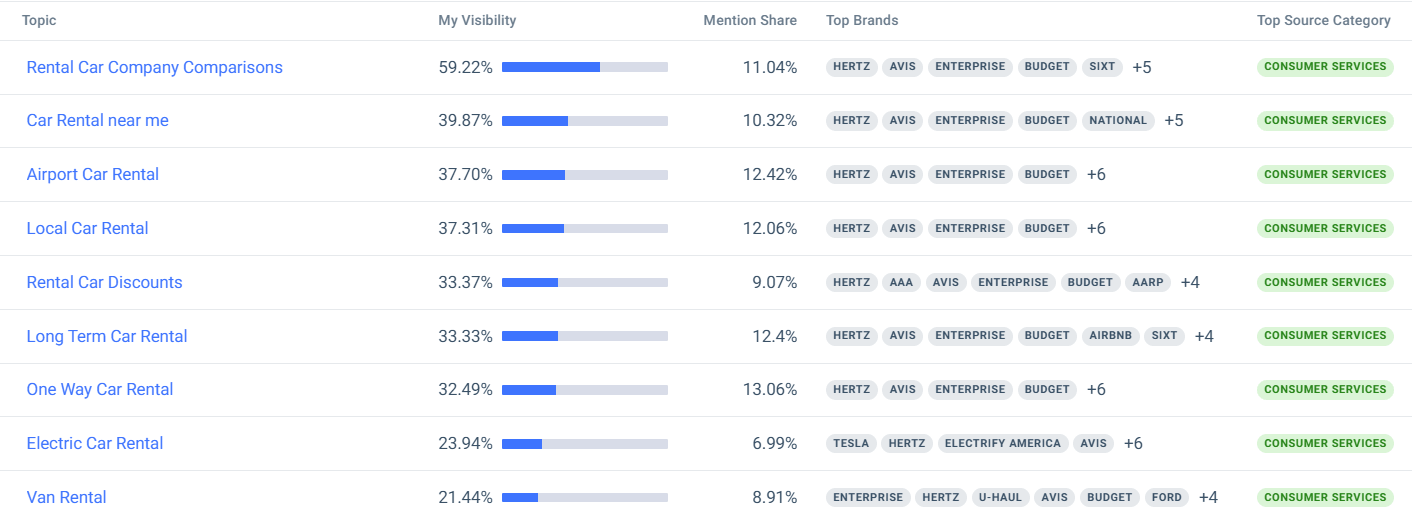
This is the highest-ROI starting point: I’m already in the conversation, I just need to be in it more. If I had picked a low-visibility topic, I’d be starting from zero. Instead, I’m building on an existing signal.
Once I’ve picked my topic, I don’t look at all prompts equally. Using the AI Prompt Analysis tool, I filtered specifically for the ones where my brand is either Not Mentioned (a content gap), Negative (a reputation risk), or Neutral (an opportunity to improve). These are the highest-priority prompts to address in my content.
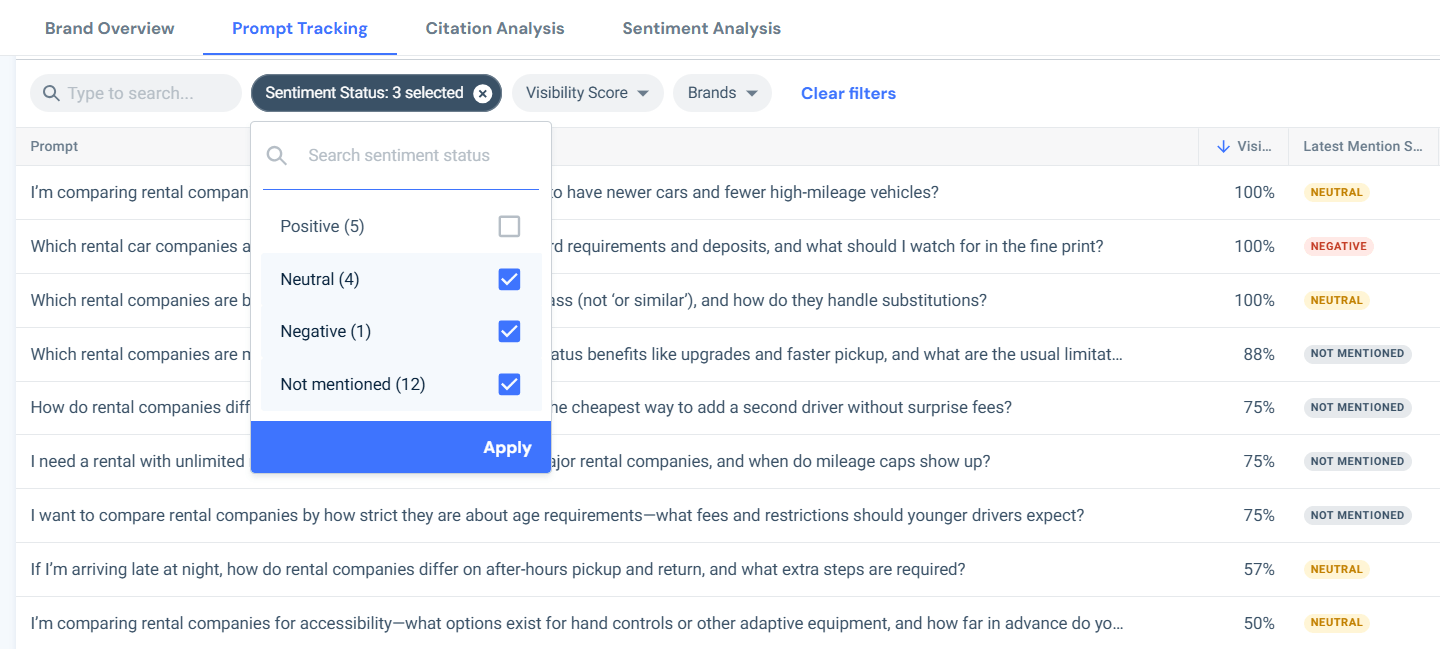
I filter out Positive mentions because those are already working. I want to find where LLMs are either ignoring me or saying something I’d rather change.
After filtering the Prompt Tracking data by Neutral, Negative, and Not Mentioned sentiment, here’s what I found: These prompts are gold. They tell me exactly what potential customers are asking AI tools, and exactly where my brand is either invisible or underperforming. Every single one of these is a content opportunity.
Here are the two I’d tackle first:
“Which rental companies offer the best loyalty status benefits?” – 88% visibility, NOT MENTIONED. LLMs answer this constantly, but Hertz never shows up. That’s a missing page, not a missing paragraph.
“Which rental car companies have the strictest credit card requirements and deposits?” – 100% visibility, NEGATIVE. Hertz is being mentioned, just not favorably. The fix is a transparent, honest page that addresses the concern directly. Owning the hard question is always better than letting a competitor define you.
Three layers: Technical, Content, and Authority. Work through them in order, technical first, so AI crawlers can actually reach your content before you invest in improving it.
Handle Technical AI Crawlability
Before any content change matters, I make sure AI crawlers can actually reach my pages. This is what we call the technical GEO step, and it’s surprisingly often broken.
Disclaimer: Current evidence suggests llms.txt has no measurable impact on AI citations, but it’s low effort and zero risk, so I still recommend adding it.
Use Schema Markup
Schema markup gives AI systems a machine-readable map of what your content contains. It’s one of the most direct signals you can send, essentially a label that says “this is an FAQ,” “this is a how-to guide,” or “this is an article from a named author.”
Update Headlines Based on Real Prompts
The prompts I found in Step 2 are literally what people are typing into ChatGPT. My headlines should speak that same language. Instead of generic SEO titles, I rewrite them to match the natural phrasing of real questions.
For example, instead of “Car Rental Comparison Guide,” I’d rewrite it as “Comparing Rental Car Companies: Guaranteed Car Class, Deposit Rules, Loyalty Benefits & More (2026).” That directly mirrors how people prompt AI tools, and it signals to LLMs that this page answers those specific questions.
Give Direct Answers (Answer-First Writing)
LLMs extract the first clear, complete statement in a section and often stop there. If the answer is buried in paragraph four, the AI never reaches it.
I rewrite every section to lead with the direct answer, then support it with context. Never make the reader, or the LLM, wade through background before getting to the point. This approach has a name, the BLUF framework (Bottom Line Up Front). We break it down fully in our AEO Guide. Open every section with a 1–2 sentence answer to the implied question, follow it with evidence and nuance, and you’ll find the writing gets cleaner for human readers at the same time.
Structure Content in Semantic Chunks
A content chunking is a self-contained unit of about 75–300 words that fully answers exactly one question. LLMs work with chunks, not full pages. If my content is one long unbroken section covering five subtopics, it’s hard for the model to isolate and cite any of them cleanly.
The fix is simple: each H2 or H3 section should cover one idea completely and stand on its own. Keep paragraphs to 3–5 sentences. Add a 2–3 line Key Takeaway summary after any section longer than 300 words. Use tables and definition boxes to break out structured comparisons, LLMs love extractable, formatted data.
Prioritize Freshness – Update Content Regularly
LLMs weigh recency when selecting sources. A 2023 guide loses ground to a 2026 article on the same topic even if the older one is technically more comprehensive. I updated the content stats, FAQs, swapping outdated examples, and adding new sections based on emerging prompts.
Add FAQs Based on Real Prompts
FAQs are one of the highest-impact formats for LLM optimization. They mirror exactly how people prompt AI tools, question in, answer out. I used the prompts from Step 2 as my FAQ source of truth. Answer each FAQ with a 1–3 sentence.
Based on my prompt data, here are the FAQs I’d add to a rental car comparison page:
Add New Sections/ Pages Based on Gap Prompts
The NOT MENTIONED prompts don’t just need FAQ treatment, many of them deserve full dedicated sections or pages. The loyalty program prompt had 88% visibility but was NOT MENTIONED. That means LLMs are answering this question constantly, and my brand isn’t in the answer at all. That’s not an FAQ gap, that’s a missing page.
Include Original Data, Statistics, and Specific Claims
Generic content gets passed over. LLMs strongly favor content with specific, verifiable claims, named statistics, original research, proprietary comparisons.
Replace qualitative statements with quantified ones wherever possible. Publish original comparison data, fleet age, average deposit amounts, loyalty tier breakdowns, even if it’s based on your own research. Cite credible external sources with clear attribution. Include a methodology note when publishing research, it signals trustworthiness to both humans and AI.
Build AI Topical Authority with Topic Clusters
A single well-optimized page is a start. AI Topical authority is what makes it stick long-term. LLMs are far more likely to cite a brand that has covered a subject comprehensively across multiple pages than one with an isolated article, no matter how good that article is.
Once the pillar article is ready: “The Complete Rental Car Company Comparison Guide”, create supporting blog posts, and include their links in the pillar. All sub-blog posts should link back to the pillar. Maintain consistent terminology across all pages. LLMs reward semantic consistency, and it also helps the model build a stronger internal knowledge graph around your brand.
Earn Third-Party Brand Mentions (Digital PR)
Research shows AI engines strongly favor earned media over content on your own site. You can publish 200 articles, but without an external citation footprint, LLMs have limited reason to surface you over more referenced competitors.
Pitch original data studies and comparison research to travel and automotive publications. Get included in “Best rental car company” roundups on high-authority review sites. Pursue expert commentary opportunities and contribute quotes to industry articles on rental trends. And make sure your brand name, tagline, and positioning are identical everywhere: website, LinkedIn, Google Business Profile, review sites, and press mentions. Inconsistency confuses the entity graph LLMs use to identify and trust your brand.
Build Presence on Reddit and Community Platforms
Reddit is the No. 2 most cited domain across all major AI platforms. OpenAI and Google have licensing deals with Reddit, which means content published there is directly ingested into major LLMs. For a car rental brand, this is one of the most accessible and highest-leverage off-site channels available.
Participate authentically in r/travel, r/roadtrips, r/personalfinance, and car rental threads. Answer the exact questions from Step 2 in threads where users are already asking them. Don’t promote, contribute. Share genuine insights about loyalty programs, deposit policies, and age requirements. Threads with high upvotes and sustained engagement have the highest chance of being cited by AI tools.
Optimization without measurement is guesswork. Traditional SEO metrics don’t capture AI search performance, and most teams are flying blind on this. Here’s how I actually track it.
The first layer is performing brand visibility analysis and AI prompt analysis, using the same tools I showed in Steps 1 and 2. I go back to it regularly to check how my brand visibility and brand-mention share are trending over time.
My goal is simple: move NOT MENTIONED prompts into NEUTRAL or POSITIVE over time.
The second layer uses the AI Citation Analysis tool. The Cited URLs report shows me exactly which pages are being pulled into AI answers, ranked by influence score.
Looking at the data, I can see that rideplusdrive.com and autoslash.com are outperforming Hertz on topics like one-way rentals and mileage policies, and Hertz’s own page only appears at position four with an influence score of 0.90. That tells me exactly which pages to prioritize and which competitor content I need to outperform.
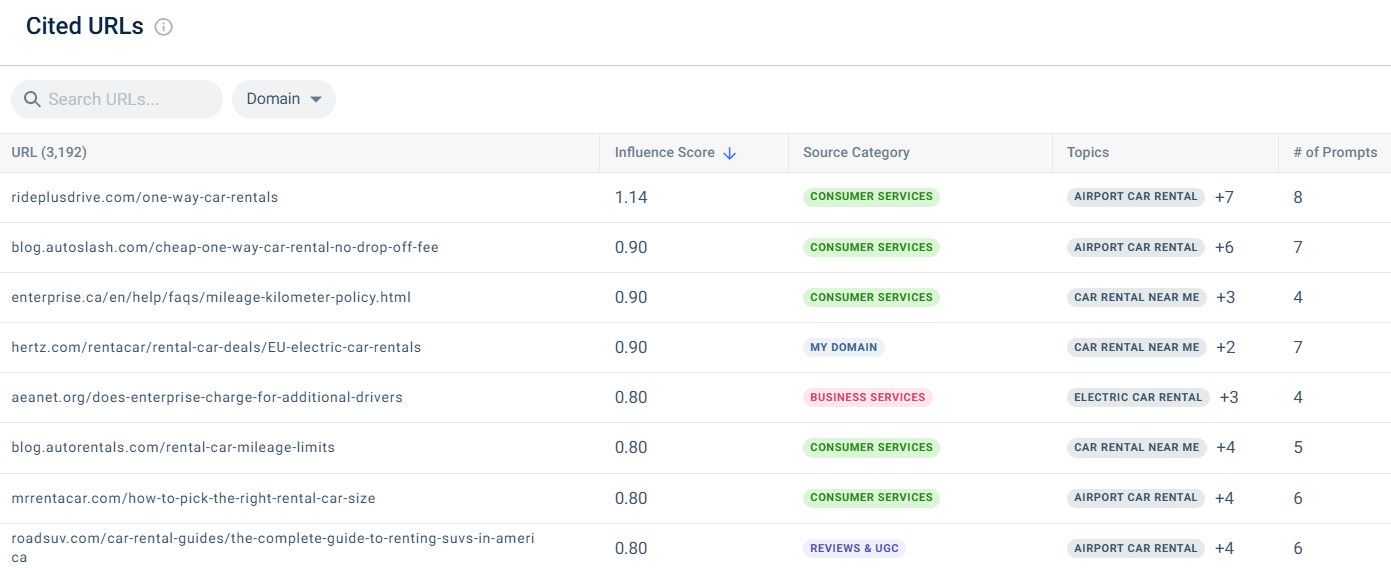
The third layer is AI-referred traffic, which I track directly from our AI Traffic Tracker. The Top Landing Pages From Chatbots report shows me which Hertz pages are actually receiving traffic from AI tools.
The homepage index page leads at 11.16% traffic share, followed by the reservations page and the one-way car rental page, both at 6.05%. This is where LLM visibility connects to real business outcomes, not just citations, but actual sessions landing on pages that convert.
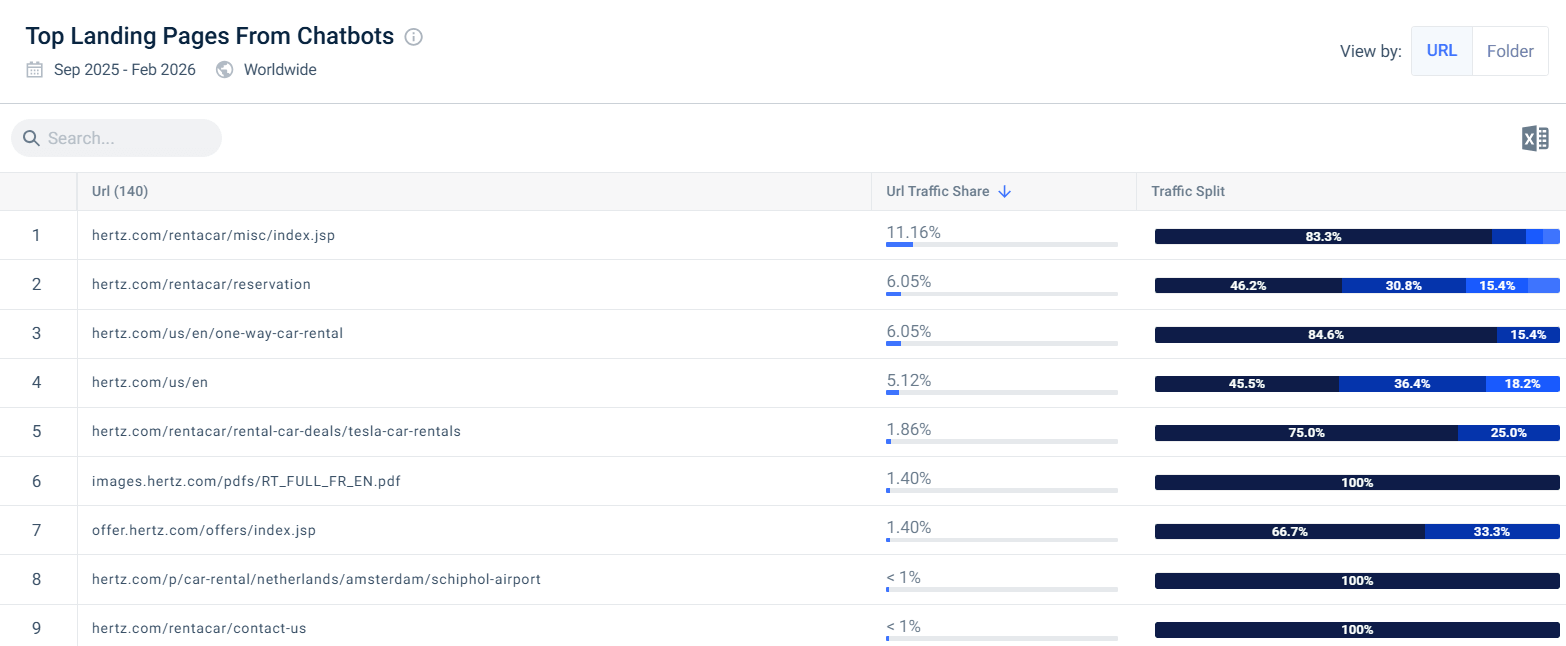
My routine is monthly prompt checks in ChatGPT, Claude, and Perplexity using the same priority prompts from Step 2, a quarterly pull of the full topic and citation report to spot new gaps, and ongoing monitoring of AI referral traffic to catch any spikes or drops that trace back to a content change or a competitor’s new piece.
This isn’t a revolution. It’s an evolution of what good content has always been: clear answers, real expertise, and earned trust. The difference is that now a machine is reading your content, not just crawling it, and the way you structure your answers determines whether you get cited or completely ignored.
The brands that move on this now will own the AI answers in their category. Those who wait will spend twice as much effort trying to catch up.
So start small. Pick one topic. Find your highest-visibility, lowest-mention-share opportunity. Map the prompts. Fix the gaps. Then measure. That’s the whole game.
Because the goal isn’t to rank anymore. It’s to become the answer.
Do I need to start from scratch or can I optimize existing content?
You can almost always optimize existing content, and that’s actually where I’d start. Take your highest-traffic pages and run them through the Step 2 process: find the relevant prompts, check how your brand appears, then apply the content recommendations. New pages are only necessary when there’s a topic or prompt cluster your site doesn’t cover at all.
Does traditional SEO still matter if I’m optimizing for LLMs?
Yes, and they reinforce each other. Most LLMs pull answers from content that’s already well-indexed by Google. A page that ranks well in traditional search is more likely to get crawled and cited by AI tools. I treat GEO as a layer on top of SEO, not a replacement for it. The structural improvements you make for LLMs, clearer sections, answer-first writing, and schema markup also tend to improve your traditional search performance.
What tools do I need to track AI visibility?
Use Similarweb’s AI Brand Visibility tools, which are what you’ve seen throughout this guide. It covers everything in one place: prompt tracking to see which questions your brand appears for and with what sentiment, and citation analysis to identify which URLs are being pulled into AI answers and at what influence score.
Is blocking AI crawlers in robots.txt ever the right move?
Some publishers block AI crawlers because they’re concerned about their content being used for training without compensation, that’s a legitimate debate worth following. But if your goal is to appear in AI-generated answers, blocking crawlers is counterproductive. You can’t be cited if you can’t be read. My recommendation: keep AI crawlers unblocked for your core product and marketing content, and engage with the training data conversation separately.
Should I write content specifically for AI or for humans?
Both, and the good news is they’re not in conflict. The best-performing content for LLMs is also genuinely useful for human readers: clear, well-structured, specific, and trustworthy. What I avoid is writing content optimized for human skimming (vague intros, buried answers, padded word count) because that’s exactly what makes LLMs skip over you. Write for a smart, time-pressed human and you’ll naturally produce something an LLM wants to cite.
What does “mention share” mean and why does it matter?
Mention share is the percentage of all brand mentions your brand receives within AI answers on a given topic. If 10 brands get mentioned across 100 AI responses about rental car comparisons, and your brand appears 11 times, you have an 11% mention share. It’s the LLM equivalent of share of voice, it tells you how dominant your brand is in the AI conversation, not just whether you show up at all. It’s the metric I care about most because it benchmarks you against competitors, not just against your own past performance.
Why is Reddit so important for AI visibility?
OpenAI and Google have licensing deals with Reddit, which means Reddit content is directly fed into their LLM training data. On top of that, Reddit threads frequently rank on page one of Google, and AI tools cite them heavily because the content reads as authentic, community-sourced, and high-trust. For most brands, participating in relevant Reddit communities is one of the fastest ways to build off-site authority that LLMs actually weigh.
I have hundreds of pages, where do I actually start?
Start with the data, exactly like I did in Step 1. Pull your AI visibility scores by topic and find the intersection of high visibility and low mention share. That’s your highest-ROI target because you’re already in the conversation, you just need to give LLMs a better reason to choose you over competitors. One well-optimized page on a high-visibility topic will outperform ten mediocre pages on topics where you have no AI presence at all.

Senior SEO Specialist at Similarweb
Maayan is a senior SEO specialist with 7+ years of experience in SEO. She loves complex research projects, creating SEO strategies and performing technical audits.

Introducing AI Ads: See Who's Advertising Inside ChatGPT, Google AI Mode, and AI Overviews
Most Searched Things on Google in 2026
The ultimate solution to help you build the best digital strategy