

You’ve hit your search limit
Start your free trial to keep exploring full traffic and performance insights.
Get StartedScrim: Light Meter & Level app analytics for September 6

Scrim: Light Meter & Level
- BERKE KAHRAMAN
- Apple App Store
- Paid
- Photo & Video
Every camera app draws you a histogram and a level. Both are confident, and both are quietly wrong.
The histogram is of the preview, after tone mapping — it cannot tell you how far past the ceiling the scene went. The level prints tenths of a degree it does not have: point the phone up and the angle comes from a component going to zero, so the number jitters while the display stays smooth.
Scrim measures the same two things and reports what it actually knows.
THE LIGHT, WITH ITS BAND
The range the preview can read, in stops, with the band split into where it comes from: quantisation (near black, one code step is more than a quarter of a stop) and sampling (a percentile read from a finite number of pixels). Systematic and random are kept apart and combined the way they should be — one adds, one adds in quadrature.
WHEN THE MEASUREMENT IS OPEN-ENDED, IT SAYS SO
If the highlights are saturated, the range is not a number but a floor: “at least 7.1 stops”. A saturated pixel may be one stop over or five, and no preview can tell you which. Scrim shows the clipping — which is observed — and refuses to invent the amount, which is not.
THE HORIZON, AND WHERE IT STOPS EXISTING
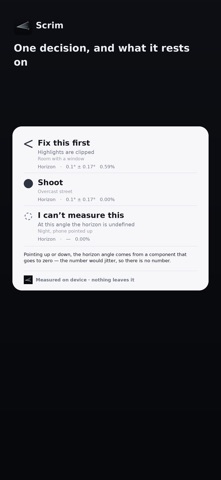
Tilt comes with a band that grows as the phone points up or down, because that is what the geometry does: the angle’s denominator goes to zero. Past a point Scrim stops printing an angle and says the horizon is undefined at this pitch. Between “level” and “tilted” there is a third answer — undecided — and you will see it often, because it is usually the true one.
CONVERGING VERTICALS, WITH THE ASSUMPTION IN VIEW
How much your verticals converge, computed from pitch and your lens. The lens has no default: without it the number cannot exist, so Scrim asks instead of guessing. The flat-façade assumption is printed next to the result.
THE DELIVERY GAP
A gain-map photo carries highlights above SDR white. How many of them a viewer sees depends on their screen, not yours. Scrim shows what an SDR screen, a typical phone and a bright HDR display each keep — and what each compresses away.
ON YOUR WRIST, ONE DECISION
Shoot · Fix this first · I can’t measure this. Phone on a tripod, you in the frame: the wrist carries the decision and its band. No histogram, no shutter, no settings — a watch app, not a remote control.
PRIVACY YOU CAN CHECK
No network requests. No frame is ever stored: preview buffers become a histogram and are released. No photo library access, no location, no account, no analytics, no identifier. Camera is the only permission the app asks for. Every one of those lines is enforced by a build gate that fails if it stops being true. The one thing that leaves the phone is the frame decision — numbers only, never an image — sent to your own paired Apple Watch over Apple’s device link.
One purchase. No subscription and no in-app purchases — the build fails if StoreKit ever appears in the source. iPhone, iPad and Apple Watch.
Store Rank
The Store Rank is based on multiple parameters set by Google and Apple.
All Categories in
United States--
Photo & Video in
United States--
Scrim: Light Meter & LevelSeptember 6, 2026