


 Marketing Intelligence
What Is an SEO Strategist: Benefits, Skills, and Strategy

Search visibility doesn’t happen by accident. It requires a clear strategy that connects technical optimization, content, and business goals. An SEO strategist sees the bigger picture, analyzing competitors, anticipating market shifts, and adapting to new search technologies. In an age of dramatic changes to the search landscape, the strategist’s role is more critical than ever.
What is an SEO strategist?
An SEO strategist is a digital marketing professional who develops and implements plans to improve a website’s visibility and ranking in search engine results (SERPs). They focus on driving organic traffic to a website by optimizing its content, structure, and technical aspects, aligning with search engine algorithms.
Unlike an SEO specialist who may handle day-to-day tasks like keyword research or on-page optimization, an SEO strategist takes a broader view. They analyze market trends, competitors, and user behavior to set long-term SEO goals and align them with business objectives. Their role often involves coordinating with content teams, developers, and marketers to ensure SEO is built into every stage of a digital strategy.
Benefits of having an SEO strategist
Having an SEO strategist on your team brings structure and direction to your search optimization efforts. Instead of treating SEO as a collection of isolated tasks, a strategist connects the work to broader business goals and ensures every decision contributes to long-term growth.
- Clear direction for SEO efforts: An SEO strategist ensures that every action supports a larger plan rather than isolated tasks, reducing wasted effort.
- Better alignment with business goals: They connect SEO work with sales, lead generation, or brand awareness targets, making results measurable and relevant.
- Stronger competitive positioning: By analyzing competitors and industry trends, they identify opportunities to outperform rivals in search rankings.
- Improved collaboration across teams: SEO strategists bridge the gap between technical, content, and marketing teams, ensuring consistent implementation.
- Sustainable growth: Instead of short-term fixes, strategists focus on strategies that build long-term visibility and authority in search engines.
Core responsibilities of an SEO strategist
Here are some of the key responsibilities of SEO strategists.
Conducting keyword and user intent research
An SEO strategist starts by identifying the terms and phrases potential customers use to search for products or services. Beyond raw search volume, they focus on the intent behind the query, whether users are looking for information, comparing options, or ready to buy.
By mapping keywords to different stages of the customer journey, they create a framework that supports both content planning and technical optimization. Continuous monitoring helps them refine strategies and adjust to changing search patterns.
Developing and executing content strategies
Content is central to SEO, and the strategist’s role is to shape it around user needs and business goals. They outline topics, formats, and publishing schedules that align with keyword research and search intent.
Collaboration with writers and editors ensures that each piece is structured for readability and optimized for search engines without sacrificing quality. They also audit existing content, updating outdated material, improving internal links, and filling gaps to strengthen topical authority.
Building and managing link profiles
Links remain a strong ranking factor, and strategists focus on building a natural and authoritative profile. This involves earning backlinks from credible, relevant sources through guest posting, partnerships, or digital PR.
At the same time, they monitor for toxic or spammy links that could harm rankings, disavowing them when needed. By maintaining a healthy link profile, they improve the site’s authority and improve its chances of outranking competitors.
Optimizing for local and international search
For businesses with a local presence, strategists optimize for location-specific searches by refining Google Business Profiles, managing local citations, and creating content tailored to regional audiences.
Companies with global reach require a different approach: implementing hreflang tags, managing multilingual content, and tailoring keyword strategies for each market. In both cases, the strategist ensures the technical setup supports discoverability across different regions and languages.
Collaborating with cross-functional teams
SEO strategies only succeed when they are implemented across the entire digital ecosystem. Strategists work closely with developers to ensure site architecture, speed, and structured data meet technical SEO standards.
Strategists collaborate with designers to balance aesthetics and usability with crawlability and performance. At the same time, they coordinate with marketing and content teams so that campaigns, messaging, and optimization efforts reinforce one another. This collaboration ensures SEO is integrated into every part of the digital strategy.
What are the key skills SEO strategists need?
Technical SEO expertise
An SEO strategist needs a strong grasp of how search engines crawl, index, and rank websites. This includes knowledge of site architecture, structured data, canonicalization, redirects, and page speed optimization. They must be able to diagnose technical issues that block visibility, such as crawl errors, duplicate content, or poor mobile usability, and work with developers to resolve them. A solid technical foundation ensures that the strategy is built on a site that search engines can properly understand and rank.
Analytical and data interpretation skills
A strategist must know how to evaluate metrics such as organic traffic, click-through rates, and conversion paths to spot patterns and measure performance. They translate raw data into insights that guide decisions: identifying what’s working, what’s underperforming, and where opportunities exist.
Creative problem-solving
Search optimization often requires finding unique solutions to complex challenges, such as ranking in a competitive niche or improving visibility for a new product. A strategist uses creativity to design campaigns, content angles, or link-building approaches that stand out while staying within SEO best practices. They combine structured analysis with innovative thinking to uncover opportunities others may overlook.
Adaptability to algorithm changes
Search engine algorithms evolve constantly, and strategies that work today may lose effectiveness tomorrow. A strategist stays informed on updates and quickly adjusts tactics to maintain rankings and traffic. This also means experimenting with new formats, like voice search, AI-generated answers, or video content, before they become standard, keeping the business ahead of competitors.
Clear communication and stakeholder management
SEO strategies involve multiple teams, from developers to executives. A strategist must explain technical concepts in plain language and present recommendations backed by data. They align stakeholders around priorities, set realistic expectations, and show how SEO contributes to business outcomes. Strong communication ensures strategies are understood, supported, and implemented effectively.
How to create an SEO content strategy with Similarweb SEO strategist agent?
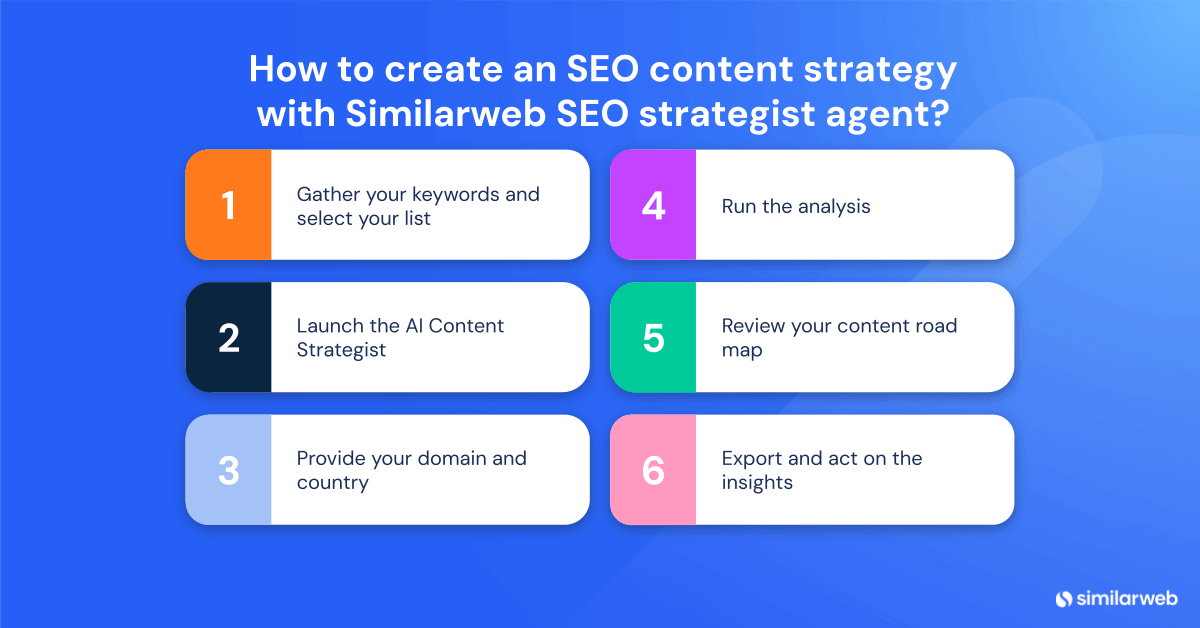
Our AI SEO Strategist agent turns raw keyword data into a tailored content road map. Instead of sifting through endless lists of phrases, you feed the tool a topic and a website and it builds a strategic plan that highlights the gaps and opportunities in search results. Here’s how to use it from start to finish.
Gather your keywords and select your list
Create or select a keyword list that represents the topic you want to rank for, for example, we used the “AI-powered CRM” list. Having a focused list helps the agent understand the context and intent of your potential audience. In the SERP Players section, choose Total Traffic, Organic Traffic, or Paid Traffic depending on the type of visibility you want to analyze.
Launch the AI Content Strategist
At the top of the SERP Players tab, you’ll see a banner inviting you to “let our SEO AI agent build your content strategy.” Click Start Content Plan. A side panel will open, prompting you to enter a domain.
Provide your domain and country
Enter the website you want to analyze for the selected keywords. In our example, we used instantly.ai, a site specializing in AI-powered outreach. The tool also uses a country setting, which defaults to the locale of your keyword list. Here, we kept it at “Worldwide” to see global opportunities. The AI agent will assemble a customized SEO content report that includes key insights, competitor comparisons, and actionable recommendations.
Run the analysis
After choosing your domain and country, click Run Analysis. The agent will begin analyzing our keyword data, SERPs, and competitor content to build your strategy.
For our AI-powered CRM example, the agent scans the top-ranking pages for each keyword, identifies which competitors dominate the SERPs, and pinpoints content gaps where instantly.ai could gain visibility.
Review your content road map
When the analysis is complete, you’ll receive a multi-section report highlighting:
- Keyword clusters and user intent: Groups of related queries mapped to stages of the funnel (e.g., “AI CRM software,” “AI CRM pricing,” “best AI CRM tools”). This helps you prioritize topics across awareness, consideration, and decision phases.
- Competitor benchmarks: Data on who is ranking for each cluster, how much traffic they receive, and what type of pages they use. This uncovers who your true SEO rivals are and which subtopics they cover.
- Content opportunities: Recommendations for new articles or landing pages and suggestions for optimizing existing content. The agent also surfaces backlinks or PR opportunities to strengthen authority.
- Technical and distribution tips: Suggestions for on-page improvements (title tags, meta descriptions, schema) and off-site tactics (guest posts, partnerships) to expand reach.
Export and act on the insights
You can download the report as a PDF or copy key sections to your clipboard. Use the keyword clusters to brief your writers, integrate competitor benchmarks into your strategy meetings, and assign technical fixes to developers. Because we draw on billions of data points, the recommendations provide a grounded perspective on what your audience is searching for and how competitors are succeeding.

How do SEO strategists measure results?
Tracking SEO performance goes beyond watching rankings. A strategist builds a measurement framework that connects search visibility with business impact. They rely on multiple data sources and metrics to understand progress and adjust strategies:
- Organic traffic growth: The most direct indicator of SEO success is the increase in visitors arriving through search engines, changes in sessions, users, and traffic quality over time.
- Keyword rankings and visibility: Monitoring keyword positions helps track progress for target terms. Strategists also use visibility indexes and share-of-voice reports to evaluate how a site performs compared to competitors.
- Click-through rate (CTR): Higher rankings do not guarantee clicks. By analyzing CTR from Google Search Console, strategists see whether title tags and meta descriptions attract users to visit the site.
- Engagement and conversion metrics: Measuring bounce rate, time on site, and pages per session shows whether traffic is relevant and engaged. Conversion tracking, such as lead form submissions, purchases, or sign-ups, links SEO directly to business outcomes.
- Backlink profile quality: Track growth in referring domains and the authority of linking sites. A healthy, relevant backlink profile is a sign of long-term SEO strength.
- Technical health scores: Regular site audits measure crawlability, indexation, mobile usability, and Core Web Vitals. These benchmarks confirm whether technical improvements are sustaining search performance.
By combining these metrics, an SEO strategist builds a clear picture of progress. They use dashboards or reports to translate data into insights for stakeholders, showing not only if traffic is growing, but also whether SEO is driving measurable business value.
Supporting SEO strategy with Similarweb
An SEO strategist helps turn search engine visibility into a sustainable business asset. They go beyond technical fixes or keyword targeting, building strategies that align search efforts with broader goals like customer acquisition and brand growth. Their work ensures SEO is proactive, not reactive.
Similarweb gives SEO strategists a range of tools to help them understand the organization’s SEO results and get valuable insights about competitors. Accurate, in-depth data is critical for staying competitive in a rapidly shifting search environment.
Whether you’re launching a new site or scaling an existing one, having an SEO strategist and equipping them with the right tools ensures every decision is backed by data, tailored to your audience, and built for long-term success.
FAQs
What does an SEO strategist do?
An SEO strategist creates and manages long-term strategies to improve a website’s visibility in search engines. Their goal is to drive organic traffic by aligning SEO efforts with business objectives through keyword planning, content development, and technical optimization.
How is an SEO strategist different from an SEO specialist?
While an SEO specialist may focus on execution, like optimizing pages or building backlinks, an SEO strategist takes a higher-level view. They develop detailed plans, analyze market trends, and ensure SEO efforts align with overall business goals.
Why is having an SEO strategist important?
An SEO strategist brings structure and long-term focus to SEO efforts. Instead of chasing short-term gains, they develop scalable strategies that support sustained growth, improve collaboration across teams, and keep the business ahead of competitors.
What skills make an effective SEO strategist?
Strong technical SEO knowledge, data analysis skills, creativity, adaptability to algorithm changes, and clear communication are key. These skills enable a strategist to interpret performance, solve complex problems, and align SEO with business needs.
How do SEO strategists measure success?
They use a mix of metrics like organic traffic, keyword rankings, engagement rates, conversions, backlink quality, and technical health. These indicators help track progress and demonstrate how SEO efforts contribute to business outcomes.

Related Posts


What Is AI Share of Voice? The Brand Mention Share Metric You’re Probably Missing




Wondering what Similarweb can do for your business?
Give it a try or talk to our insights team — don’t worry, it’s free!