
Most Searched Things on Google in 2026
by Maayan Zohar Basteker15 Min.
Oct 15, 2026
 Ecommerce Intelligence
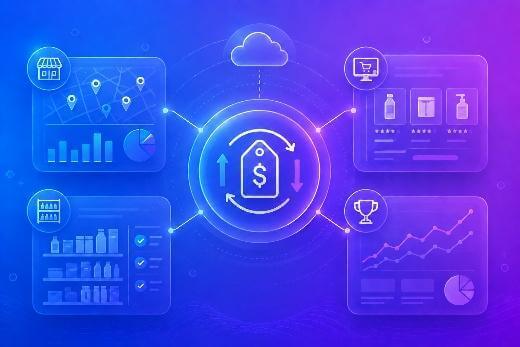
A shopper searches for a moisturizer on a retailer’s app, checks the price on a marketplace, reads reviews on social media, then buys it in a physical store two days later. That path is normal now. The average retail shopper interacts with six touchpoints before buying, and 73% of shoppers move across multiple channels during that journey, according to a Harvard Business Review study of 46,000 consumers. Brands built for a single-channel world are guessing at half the picture.
Being everywhere is now table stakes for brands. Staying on top of it all, without losing the overview, is the hard part. Keeping that overview, and tracking the competition just as closely, is exactly the gap retail intelligence exists to close.
Retail intelligence gives brands and retailers a live, connected view of pricing, availability, and shopper behavior, both online and in physical stores, so that assortment and marketing decisions can be made before it’s too late to act. The digital shelf, the online space where your products are discovered, compared, and clicked, is the part of that discipline most CPG teams touch daily. It’s one layer of a wider practice.
This article defines retail intelligence, separates it clearly from the neighboring terms retail analytics and digital shelf analytics, walks through how the data actually flows from shelf to decision, and makes the case for why the discipline has become harder to skip now that shopping itself runs through more channels than ever, AI assistants included.
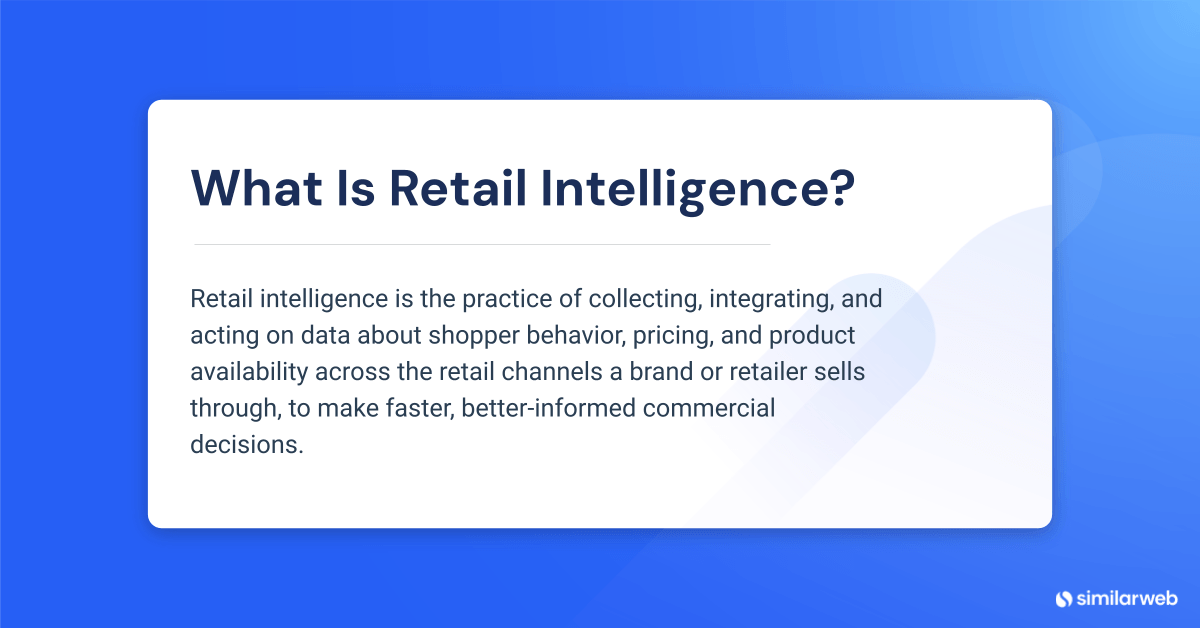
Retail intelligence is the practice of collecting, integrating, and acting on data about shopper behavior, pricing, and product availability across the retail channels a brand or retailer sells through, to make faster, better-informed commercial decisions.
The term started in physical stores, long before anyone talked about a digital shelf. Retailers were already running retail intelligence with point-of-sale data, foot traffic counters, and motion sensors that showed which aisles and shelf positions converted.
That in-store layer still matters. A McKinsey and ICSC survey of 3,004 US shoppers found that, across product categories, consumers were most likely to report shopping mostly in physical stores for groceries and for health, beauty, and personal care, which means a beauty brand that only watches its online shelf is missing where a large share of its category still transacts.
Over the last decade, the addition of a digital layer with far more granular and faster-moving data than any in-store sensor could produce has changed things. Today, retail intelligence helps companies understand three things: what is happening in the retail market, the reasons why this is happening, and what they should do next.
|
Area |
What it helps you understand |
| Market intelligence | Market size, trends, growth opportunities, and emerging competitors |
| Competitor intelligence | Competitor pricing, promotions, product assortment, and positioning |
| Customer intelligence | Shopping behavior, preferences, demographics, and purchasing patterns |
| Product intelligence | Which products sell well, where they are available, and how they perform |
| Location intelligence | Store locations, catchment areas, foot traffic, and expansion opportunities |
| Pricing intelligence | Price differences, discount strategies, and price competitiveness |
| Sales intelligence | Sales performance, demand patterns, and opportunities to increase revenue |
Similarweb’s Retail Intelligence suite combines these layers across Amazon and hundreds of other online retailers and marketplaces.
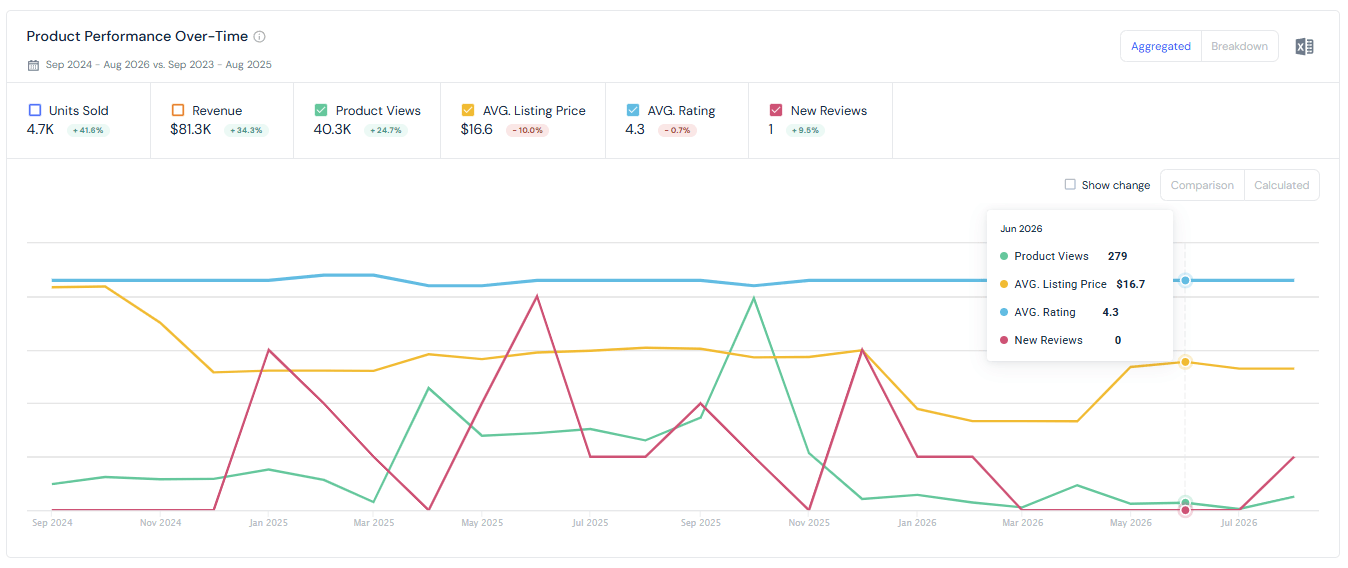
That breadth is what separates retail intelligence from a single dashboard: no one data source, on its own, tells you why a competitor’s views spiked or where your own assortment has a gap. Its product performance view, for instance, rolls sales, pricing, and reviews & ratings data into one screen, rather than leaving a team to reconcile separate exports by hand.
These three terms get used interchangeably, and that’s the single biggest source of confusion for anyone new to the space. Retail analytics is the broadest and most backward-looking of the three. Retail intelligence narrows the focus to real-time, decision-ready signals across channels. Digital shelf analytics narrows it further, to how products perform on retailer and marketplace pages.
| Dimension | Retail analytics | Retail intelligence | Digital shelf analytics |
|---|---|---|---|
| Time orientation | Backward-looking: what happened last quarter | Near real-time: what’s changing this week, what to do next | Real-time to weekly, scoped to online listings |
| Core question | Why did sales trend this way? | What’s changing right now that needs a response? | Is my product visible, available, and priced right? |
| Data source | Internal sales and inventory systems | Shopper behavior and product data across retailers, overlaid with internal numbers | Scraped or monitored retailer product pages |
| Example metric | Quarterly sales by category | Same-day price gap vs. a named competitor | Share of shelf rate on a given marketplace |
The three nest inside each other: each feeds data to the next. Digital shelf analytics functions as a sub-discipline of retail intelligence. It supplies the shelf-level signals (search rank, content quality, price, availability), which retail intelligence enriches with broader shopper behavior and omnichannel context. Similarweb’s own product split mirrors this: Digital shelf analytics covers the shelf-level signals, while Cross-Retail IQ and Amazon IQ layer the shopper-behavior and omnichannel context on top.
A working retail intelligence practice pulls from three distinct data streams, and the real value shows up only once they’re connected to each other.
Online data covers what’s visible on the digital shelf itself: pricing and promotions across retailers, product content (titles, images, descriptions), stock and availability signals, and the search rankings that determine share of search.

Sephora’s share of views and click share in the body moisturizers category, Similarweb Cross-Retail-IQ data, August 2025 – August 2026
Offline data captures the physical store side: foot traffic, dwell time near a display, shelf space allocation, and in-store stockouts. For brands selling across channels, this is the piece that’s easiest to lose track of, and the one that connects back to the omnichannel behavior described below.
Internal data provides the baseline: your own sales figures, revenue by channel, return rates, and trade spend. Without it, external market data has nothing to compare against. You’re watching the market move but can’t tell whether it’s moving in your favor. This is the layer Similarweb’s Amazon Sales Analytics is built to sit alongside: weekly, ASIN-level sales and traffic data benchmarked against the category and named competitors, so a team isn’t just watching the market move — it can see whether that movement is working for or against it.
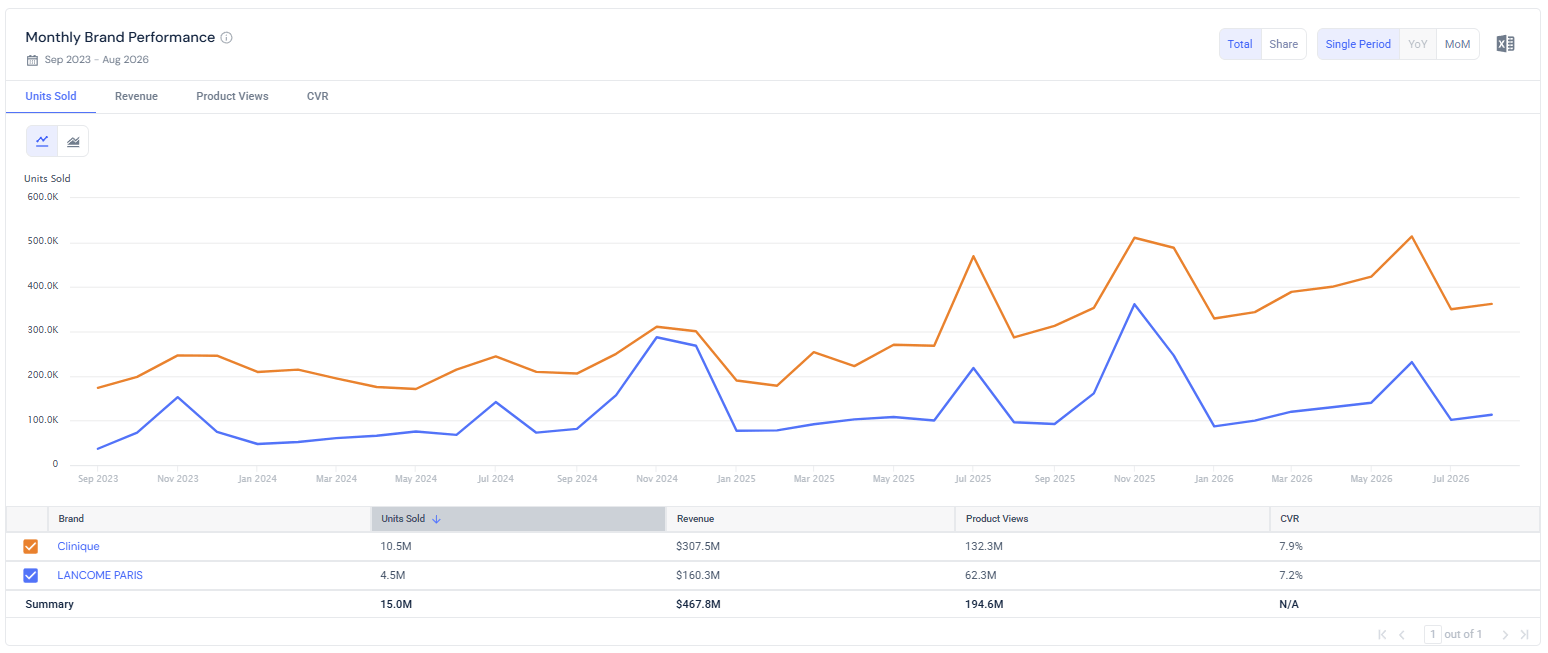
Benchmarking of Clinique and Lancôme’s sales performance using Similarweb’s Amazon sales analytics data from September 2023 to August 2026.
Here’s how the distinction plays out in practice. The digital shelf produces raw signals, such as a product’s position in on-site search results, its price relative to competitors’ prices, and whether the product is in stock. Retail intelligence takes these signals and combines them with shopper behavior data to make decisions such as repricing an SKU, fixing a listing, or shifting retail media spend to a specific keyword.
Without the digital shelf, there are no online signals to act on. Without retail intelligence, the digital shelf is just a pile of unread data. Without linking to inventory data or sales performance, decisions default to gut instinct.
Retail intelligence earns its keep in specific, recurring situations. Each of the use cases below follows the same shape: a visibility gap, the data needed to close it, and a concrete outcome.
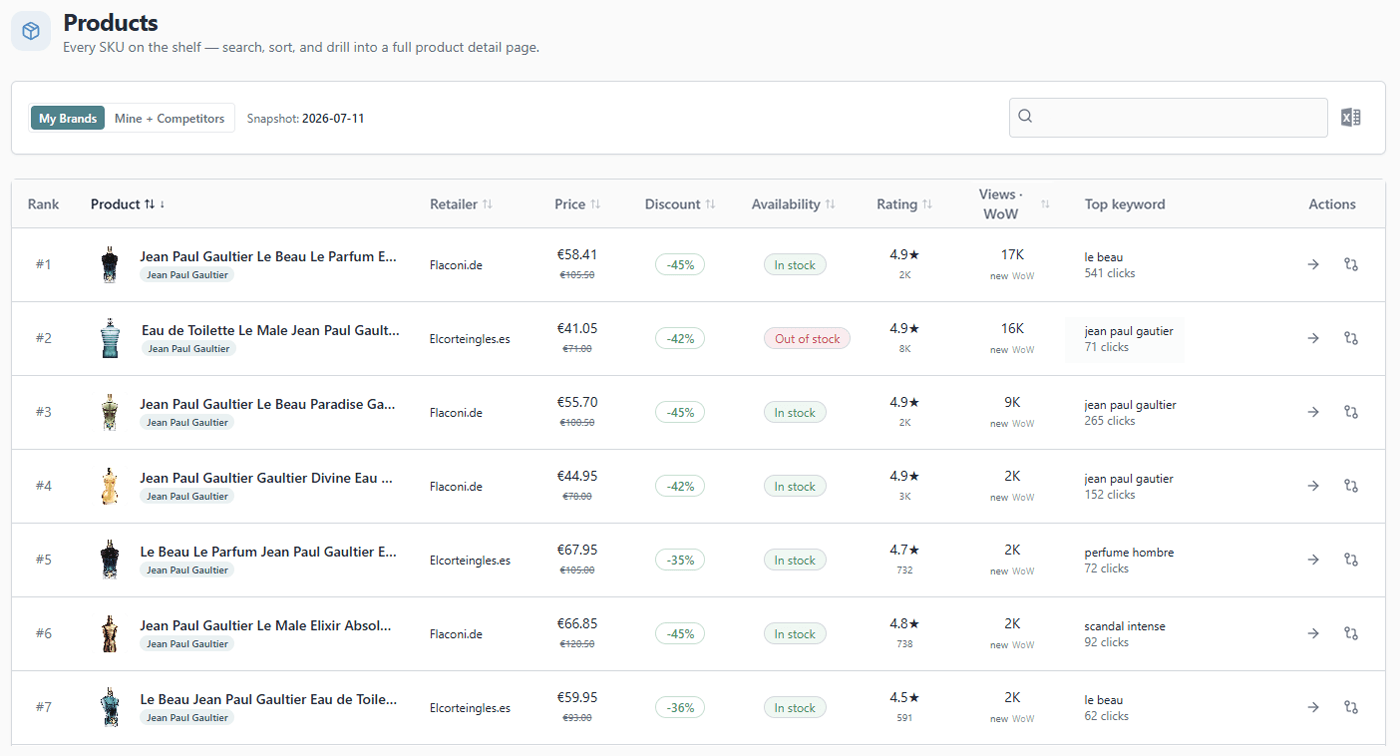
A product priced competitively on one retailer can be quietly undercut on three others, and without active tracking, the first sign is usually a sales drop that surfaces weeks later. Real-time pricing data across retailers catches the gap the moment it opens, so a pricing team can respond same-day. Similarweb’s Retail Price Intelligence module is built for this exact scenario. For the fuller mechanics of how a price benchmark gets built, see What Is Price Intelligence?
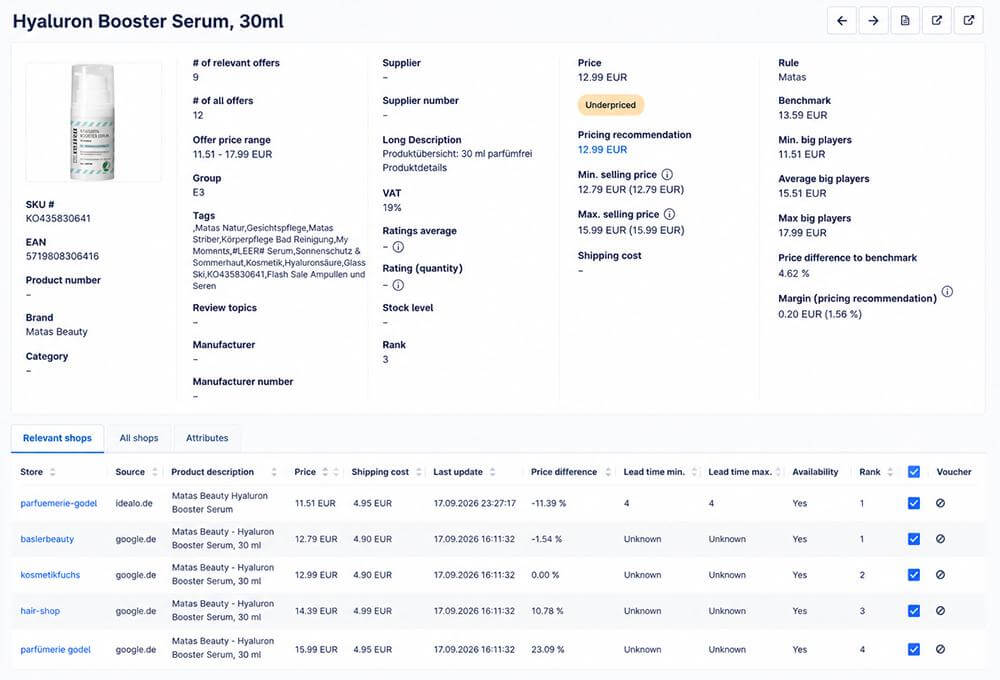
Similarweb digital shelf analytics data, price intelligence benchmarking view, August 2026
A high-volume SKU going out of stock online can bleed a week of sales before a manual check catches it. Availability monitoring flags a stockout within hours, giving a team time to expedite replenishment or redirect ad spend to an in-stock alternative before the loss compounds.
Similarweb’s digital shelf analytics availability tracking is designed to close this gap: it identifies out-of-stock and missing listings across retailers, alongside real shopper demand. This enables teams to prioritize stockouts that are costing sales.
Weak conversion on a product page is more often a content problem than a demand problem. Comparing listing quality, images, and attribute completeness against competitor listings on the same retailer site shows exactly where a page falls short, and fixing titles or adding missing attributes typically lifts both conversion and search visibility. Similarweb’s digital shelf tooling scores this automatically at the SKU level — titles, bullets, and image counts against a category benchmark — so a content team knows which listings to fix first instead of auditing pages one by one.
Trade promotion spend that isn’t translating into sales often has a visibility mismatch behind it, such as strong online search rank paired with weak in-store placement during the same promotional window. Combining online ranking data with offline placement data surfaces the mismatch so it can be renegotiated before the next campaign. Similarweb’s on-site search optimization view is usually where this mismatch shows up first, since it tracks keyword-level search rank and click share for the exact terms a promotion is meant to support.
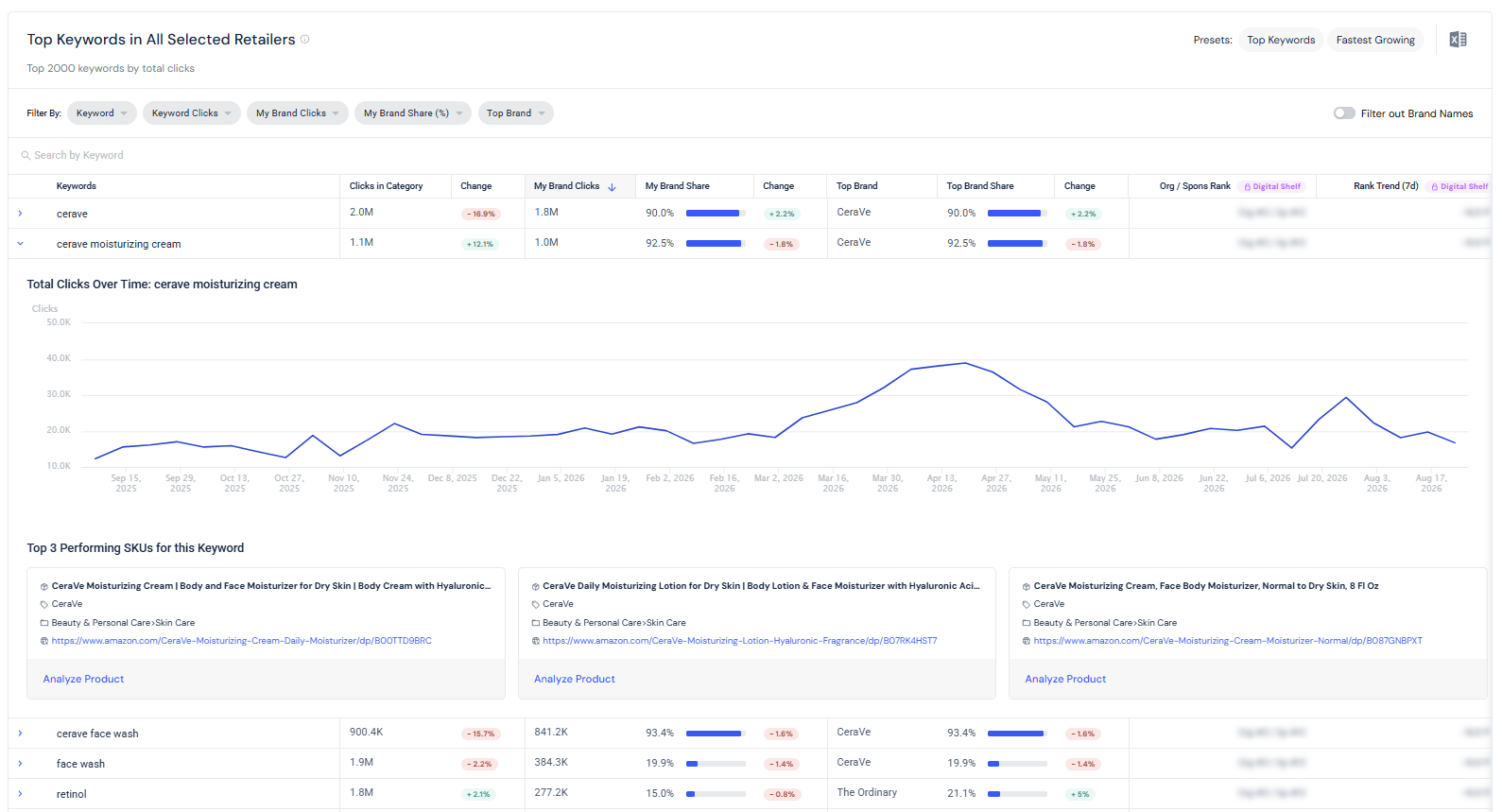
CeraVe’s top keywords, Similarweb Cross-Retail-IQ data, September 2025 –September 2026
When a meaningful share of online browsers convert in-store within a few days, attribution models built on click-to-purchase alone systematically undercount marketing’s real contribution, and budget ends up misallocated. Similarweb cannot track in-store data. But Similarweb’s cross-retail shopper behavior data is built to quantify cross-shopping and switching patterns, giving a team a unified, product-level view of how shoppers browse, search, and engage with brands across hundreds of digital retailers, all in one place.
Seasonal and trend-driven demand spikes can catch teams off guard when forecasts rely too heavily on last year’s sales. Combining historical sales data with current search trends and competitor activity can surface shifts in demand earlier, giving teams valuable lead time to adjust inventory orders. Similarweb’s consumer demand insights add these early demand signals to historical performance data, helping teams spot emerging trends and act before they turn into stockouts.
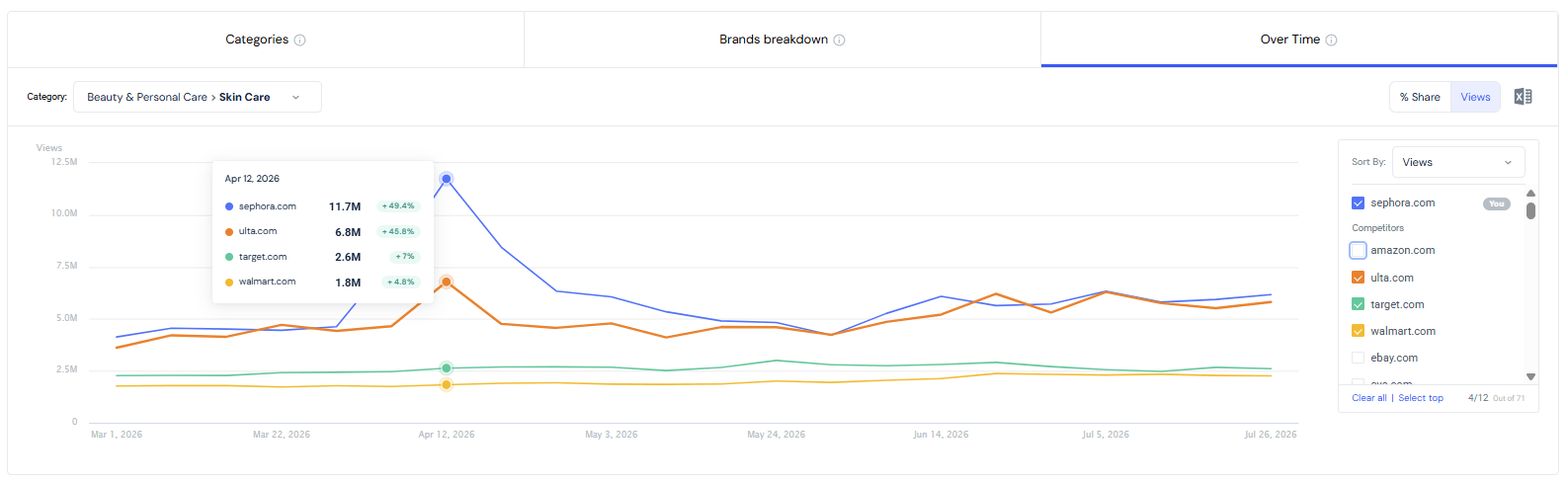
Sephora’s traffic share in the skin care category, Similarweb Cross-Retail-IQ data, March 2026 – August 2026
The idea behind retail intelligence has been around for years. What’s changed is the cost of not having it. Inventory distortion, the combined cost of stockouts and overstocks, drains an estimated $1.73 trillion a year from retailers globally, with out-of-stocks alone accounting for roughly $1.2 trillion of that total. Separately, 44% of retail media traffic lands on product pages that aren’t “retail ready” (out of stock, poorly optimized, or mispriced). Put those together, and the pattern is hard to miss, as money leaves before anyone notices the shelf is broken.
Now add where discovery is heading. Using Similarweb’s AI traffic tracker, we see that Sephora.com received an estimated 820,000 visits from ChatGPT alone between April and July 2026.
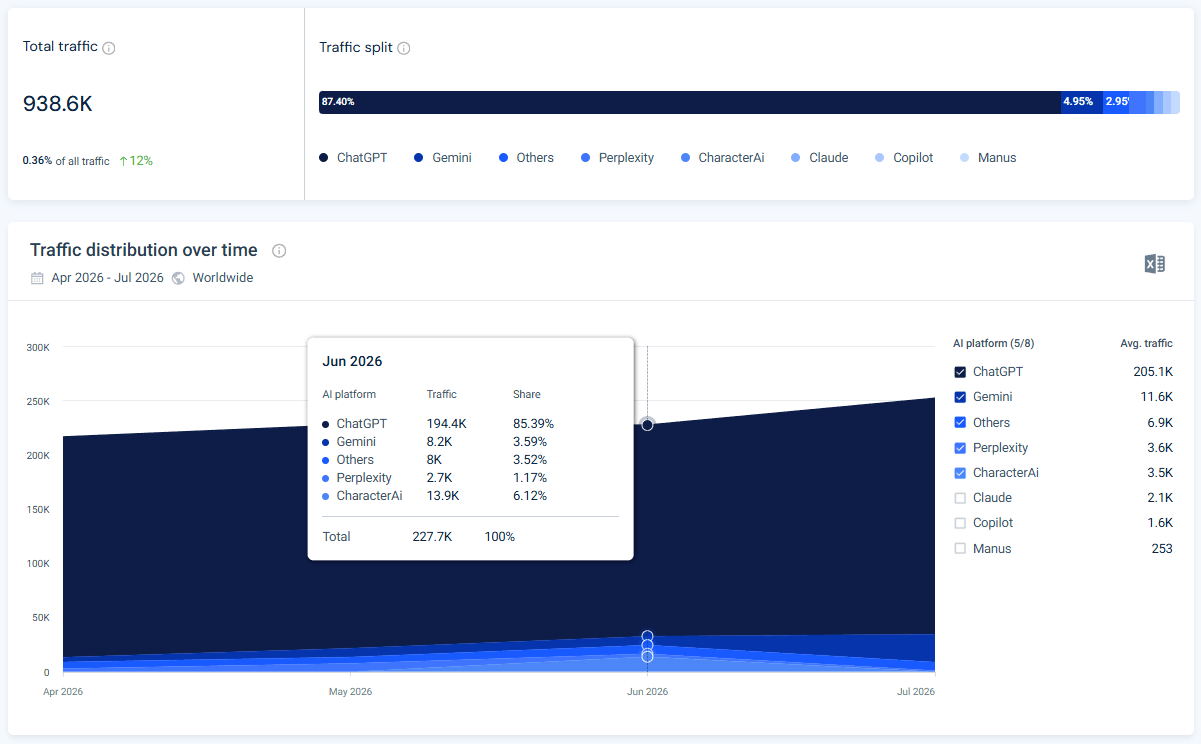
Sephora.com Similarweb AI Traffic data, April-July 2026, worldwide
That’s a measurable, current share of how a major beauty retailer’s digital shelf is already being reached, and it’s happening outside the traditional search results page most digital shelf strategies were built around.
McKinsey puts a number on where this goes: AI agents could orchestrate $3 trillion to $5 trillion in global retail revenue by 2030 as discovery, comparison, and eventually transactions shift away from the search bar toward AI interfaces.
That shift raises the value of clean, accurate, structured product and pricing data, because an AI assistant surfacing, comparing, and recommending products needs the same underlying signals a human category manager does, just consumed at machine speed. A brand that can’t answer “why did our category share move this week” with data isn’t ready for AI-mediated discovery either. Retail intelligence is the layer that makes both problems solvable at once.
The benefit splits differently depending on which side of the shelf you’re standing on, though both sides end up working from the same data. For brands, the clearest gain is negotiating leverage: walking into a retailer business review with current pricing, availability, and competitor data changes the conversation from “we think” to “here’s what happened this week.” For retailers, the benefit shows up in assortment decisions, since knowing what’s selling versus what’s sitting on the shelf reduces both overstock and stockouts. For both sides together, a shared data foundation removes friction that otherwise shows up as an argument over whose numbers are right.
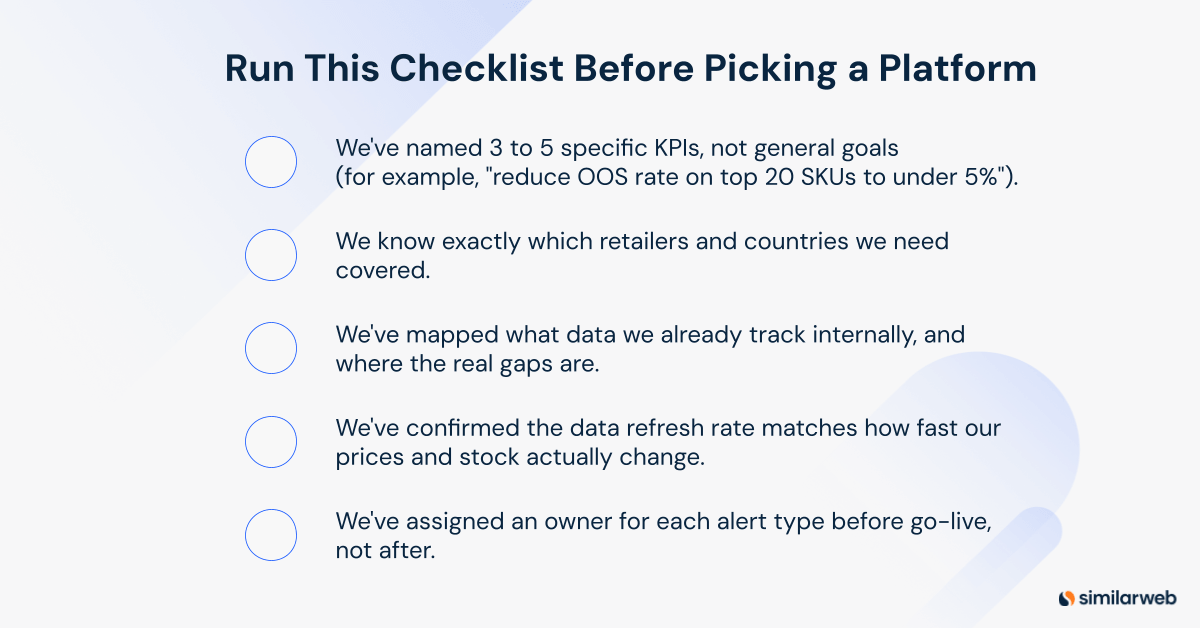
Adopting retail intelligence well is less about buying a tool and more about sequencing four decisions in the right order.
“Get five SKUs off the out-of-stock list within 30 days” tells a team exactly what to aim for, in a way “improve visibility” never will. The goal determines which metrics matter, and skipping this step is the most common reason a new platform sits unused.
Most companies already have pieces of this scattered across systems: sales figures in one place, promotional performance in another, competitive notes in a spreadsheet someone updates by hand. Map what’s already tracked and where the real gaps are before evaluating a new tool.
A platform covering 20 retailers you don’t sell on is less useful than one covering the five you compete on. Check how current the data is (weekly beats monthly for anything price- or stock-related) and whether it fits into the tools your team already uses daily. As a benchmark, Similarweb’s Retail Intelligence refreshes weekly across 650+ retailers in 70+ countries, which is a reasonable bar to hold any shortlist against.
A platform nobody checks is a wasted subscription. The fix is role-specific dashboards, since a category manager and an ecommerce lead need different views of the same data, plus a simple playbook: when a stockout alert fires, who does what, in what order, by when.
Retail intelligence shortens the distance between noticing a problem and fixing it. A brand or retailer that can see a price gap, a stockout, or a ranking drop the same week it happens has a real structural advantage over one that finds out next quarter, and that advantage compounds every week the gap goes unnoticed. The categories that look calm in a quarterly report are rarely calm week to week. Retail intelligence is how you see the difference before your competitors do.
Similarweb’s Retail Intelligence platform brings together shopper behavior, pricing, and assortment data across Amazon and hundreds of other retailers and marketplaces. This allows category managers to spend less time explaining what happened and more time deciding what to do next. If you want to see it against your own category, you can start with a free trial or a personalized demo.
Retail intelligence is the practice of pulling together pricing, availability, and shopper behavior data from online and offline retail channels so a team can react to what’s happening now. Think of it as the difference between a rearview mirror and a live dashboard.
Retail analytics is broader and backward-looking: sales trends, inventory turnover, customer segments. Retail intelligence narrows that focus to real-time, actionable shelf data, such as pricing, stock, and competitor moves, so it’s less about explaining last quarter and more about deciding what to do today.
Digital shelf analytics is retail intelligence applied to the online shelf: product visibility, pricing, availability, and content on retailer and marketplace pages. Retail intelligence is the wider practice, which can include offline, in-store signals alongside the digital shelf.
Three streams matter most: online data (pricing, content, availability, and search rank across retailer sites), offline data (in-store traffic, shelf placement, stockouts), and internal data (your own sales, margin, and trade spend). The value comes from connecting all three, since any one stream alone leaves you guessing at the rest of the picture.
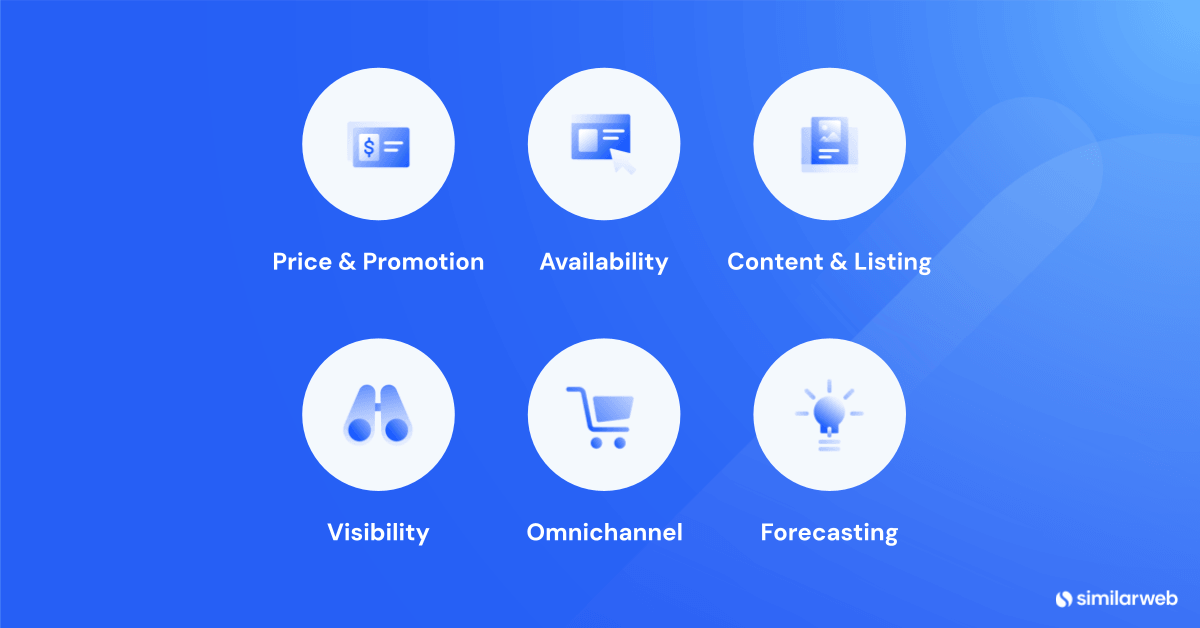
The most common are price and promotion monitoring, out-of-stock prevention, listing and content optimization, shelf visibility across online and offline channels, omnichannel journey tracking, and demand forecasting. Most teams start with pricing or stockouts before expanding to the rest.
Ecommerce and category managers at consumer brands use it to explain share shifts and spot growth opportunities. Pricing and trade marketing teams use it to monitor MAP compliance and allocate budget across retail partners. Retailers and marketplaces use the same kind of data to benchmark their own assortment and category performance against competitors.
Start by naming specific KPIs instead of general goals, then map the data you already have internally, and evaluate platforms mainly on retailer coverage and data freshness. Assign an owner for each alert type before launch, so the data turns into action instead of sitting in an unread dashboard. If you’d rather look at live data before finalizing KPIs on paper, Similarweb’s Retail Intelligence offers a free trial so you can explore your own category first.

by Ida Lorenz
Content Writer & Marketing Manager
Ida is a Content Writer & Marketing Manager at XPLN, specializing in Digital Shelf Analytics, ecommerce, and digital transformation. With 18 years of experience in B2B marketing, she transforms complex data and technical concepts into clear, actionable content that helps businesses navigate the evolving digital commerce landscape. She holds a Diploma in Media Studies with a focus on Media Informatics from the University of Paderborn, Germany, and is also a certified Graphic Design Assistant. Her published articles combine data-driven insights with compelling storytelling to help companies understand how the digital world is changing and what it means for their business. Outside of work, she enjoys reading, hiking, spending time with her family, and discovering great coffee.
Put the full picture at your fingertips to drive product views and sales