





Top Ecommerce Companies in the USA: The 100 Brands Winning the Traffic Race in 2026
by Inbar Eytan6 Min.
Aug 30, 2026
 Ecommerce Intelligence
37.6% of ecommerce in the U.S. happened on Amazon, with other platforms far behind (for comparison, eBay has only 3%). To win a share of this market, you need Amazon SEO. Amazon has its own search algorithms, which are quite different from Google’s. We’ll show how to master them and drive measurable growth in sales and conversions on your Amazon product page.
Amazon SEO (Search Engine Optimization) is the process of optimizing product listings to rank higher in Amazon’s search results, resulting in higher traffic and sales. Amazon SEO was always important, but given that Amazon advertising costs have increased 48% in the past few years, it is becoming a critical component of seller success.
More than half of all online shoppers now begin their product searches on Amazon, not on traditional search engines. This shift in consumer behavior makes it critical for sellers and brand leaders to understand how Amazon SEO works.
Amazon SEO involves optimizing relevance factors, such as structuring titles, bullet points, product descriptions, images, and backend keywords, so they align with how customers search.
This may sound similar to on-page SEO for Google, but the similarity ends there. Because Amazon SEO is purely transactional, with customers already looking to buy, there is a much bigger emphasis on performance factors. These are signals tied to sales performance on Amazon, like conversion rate, pricing, and sales velocity, which have a critical influence on Amazon search rankings.
By improving these factors, you can achieve higher sales at lower cost, giving you the edge in an intensely competitive online marketplace.
The rise of AI-powered search tools and answer engines has led to the “zero click” phenomenon, where users get answers directly on Google or other platforms without visiting websites. For most businesses, this means less organic traffic, fewer clicks, and a shrinking return on traditional SEO practices. However, Amazon does not follow this pattern: it still drives intent-rich traffic directly to product listings, where every click has a high chance of converting into revenue.
At the same time, generative AI platforms like ChatGPT, Perplexity, or Google’s AI Overviews increasingly act as intermediaries, summarizing information instead of sending users to websites. This is disruptive for publishers and brands that rely on web traffic. But on Amazon, the user journey is different because shoppers arrive with a clear purchase intent. Amazon SEO ensures your products are visible at the critical decision point, bypassing the traffic losses happening elsewhere.
For brands navigating the shift toward AI-driven discovery, Amazon offers a rare certainty: ranking well still means reaching real buyers. Ranking high on Amazon search results is a powerful ecommerce tactic as well as a core part of a forward-looking digital marketing strategy. As traffic fragments across AI platforms and websites lose traffic, Amazon SEO provides a clear advantage in visibility, with guaranteed exposure to real buyers.
To compete effectively on Amazon, you need to understand the algorithm. Both newcomers to Amazon marketing and seasoned sellers need to understand the changes Amazon has made to improve its search technology in recent years. Amazon transitioned from the legacy A9 algorithm to the newer A10 algorithm and added AI components to its search mechanism, making optimization more nuanced and complex.
The A9 algorithm was Amazon’s core search system for many years. It ranked products based on a mix of relevance signals, like keyword usage, and performance signals, such as sales history and conversion rates. A9 gave heavyweight to keyword placement in product titles and backend fields, rewarding listings that matched customer searches directly. Paid ads also played a significant role, with strong ad spend often improving organic rankings.
However, A9 had limitations. It was highly dependent on keyword matches, which led to keyword stuffing and low-quality listings ranking well. It also prioritized short-term sales velocity, which could be manipulated through aggressive discounting or promotional tactics. While it worked for surfacing popular products quickly, it didn’t always deliver the best customer experience.
The transition from Amazon’s A9 algorithm to A10 marked a shift in several areas:
Over the years, like other search engines, Amazon has adopted AI-driven systems that can provide better results to users, but also make optimization more complex for sellers. AI systems like COSMO and RUFUS have transformed Amazon’s search engine from a keyword-matching tool into a complex, intent-driven ecosystem.
COSMO now interprets customer queries by analyzing their underlying context, not just the exact words they type. This shift means sellers must move beyond traditional keyword stuffing and create listings that address customer intent. If your product title, bullets, and descriptions don’t speak clearly to the buyer’s needs, like portability for students or ease of cleaning for appliances, your listing may be ignored, regardless of keyword usage.
RUFUS brings conversational AI into the customer experience, allowing shoppers to ask nuanced questions and receive tailored responses. But this also raises the bar. RUFUS pulls details from your listing content. If your product page lacks clarity or skips common customer concerns, it won’t show up in AI-generated answers. This could cost you visibility and conversions.
With the A10 algorithm and new AI systems, Amazon SEO strategies have shifted from simple keyword optimization to a more holistic, customer-focused approach. Sellers now need to consider factors that go beyond traditional on-platform SEO:
Here’s where your keywords are important. The content types listed below should include the relevant keywords. Let’s use one of my favorite products as an example: the Magic 8 Ball!
The product title is the most influential on-page relevance factor in Amazon SEO. It should clearly describe the product and include primary keywords that reflect how customers search. Amazon’s algorithm weighs the words at the beginning of the title more heavily, so front-load your highest-value keywords.
A strong product title typically includes the brand name, product type, key features (such as material, size, or quantity), and unique selling points.
For example, the current title for the Magic 8 Ball is:
“Mattel Games Magic 8 Ball Kids Toy, Retro-Themed Novelty Fortune Teller, Ask a Question & Turn Over for Answer (Amazon Exclusive)”
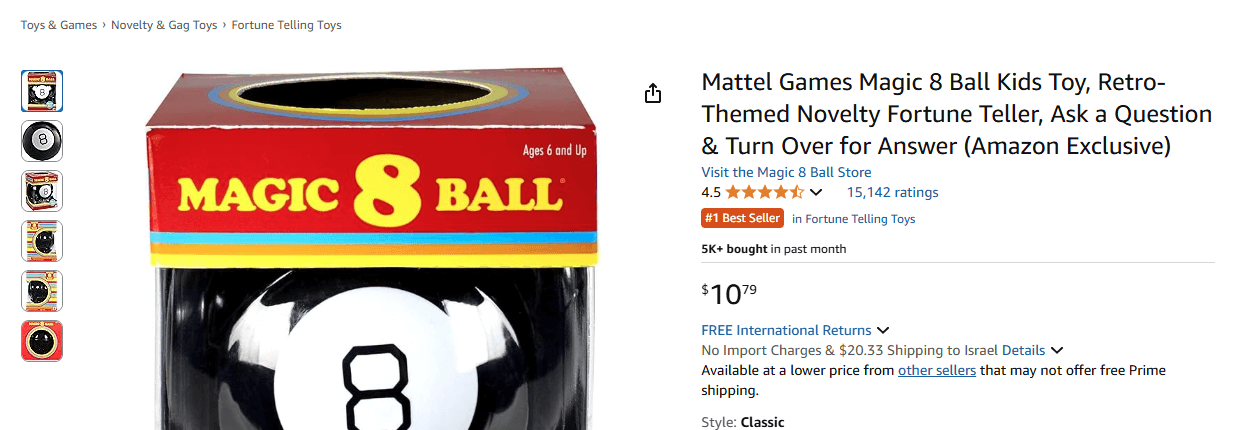
This title includes the brand name (Mattel Games), the product name (Magic 8 Ball), and several descriptive elements like “kids toy” and “novelty fortune teller”.
Avoid keyword stuffing or excessive punctuation. Focus on clarity, relevance, and mobile readability. Titles should ideally be under 80 characters for optimal display across devices.
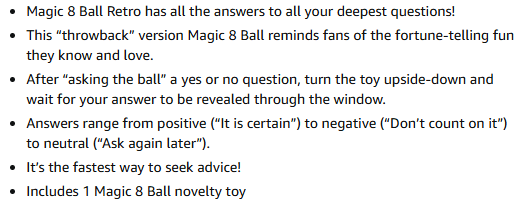
Bullet points serve as a quick-scan overview of your product’s main benefits and specifications. Use each bullet to highlight different attributes: materials, size, use cases, safety, compatibility, or warranty. Prioritize clarity and include keyword variations without forcing them.
Use five bullet points and format them consistently. Start with a short descriptor (e.g., “Durable Build:”) and follow with a concise benefit. Think from the buyer’s perspective: What would they want to know before purchasing?
The bullets for the Magic 8 Ball highlight nostalgia, play value, and answer variety, but they would be stronger if written in the “descriptor + benefit” format (e.g., Retro Design: Classic fortune-telling fun). This would improve clarity and keyword use.
The product description allows for a more detailed explanation. Here you can tell the story behind the product, elaborate on features, and incorporate long-tail and secondary keywords. Use short paragraphs, formatting (like bold text or line breaks), and persuasive language to maintain readability and conversion.
The 8 ball’s description effectively tells the story and explains how the toy works, while evoking nostalgia. To further boost conversion, it could also emphasize use cases like gifting or party fun. Together, the bullets and description balance quick-scan details with a fuller emotional appeal.

Backend search terms are used by Amazon’s algorithm but are invisible to customers. This field allows you to include additional keywords that didn’t fit naturally into your listing, like common misspellings, synonyms, abbreviations, or foreign language terms.
Avoid duplicating keywords already used in your visible content. Instead, expand your keyword coverage. For instance, if you sell a yoga mat, backend terms might include “exercise mat”, “pilates mat”, or “non-slip mat”.
Amazon limits this field to 250 bytes, so use the space efficiently. Skip punctuation, articles, and conjunctions. Focus on breadth and diversity rather than repetition.
Likely backend terms for the Magic 8 Ball would include variations and related phrases not covered in the bullets or description, such as “fortune teller toy”, “prediction ball”, “decision maker toy”, “yes no ball”, “retro novelty gift”, “mystic 8 ball”, “party game toy”, and “fun gag gift”. These expand keyword coverage by capturing synonyms, use cases, and buyer intents beyond the main “Magic 8 Ball” term.
Choosing the correct product category and subcategory is critical for relevance. Amazon uses this information to determine where your product appears in filtered searches, navigation menus, and category-specific promotions.
If your product is misclassified, it may be buried in irrelevant search results or excluded from category-specific rankings. Use Amazon’s Product Classifier or review top-selling competitor listings to confirm you’ve selected the most specific and accurate category available.
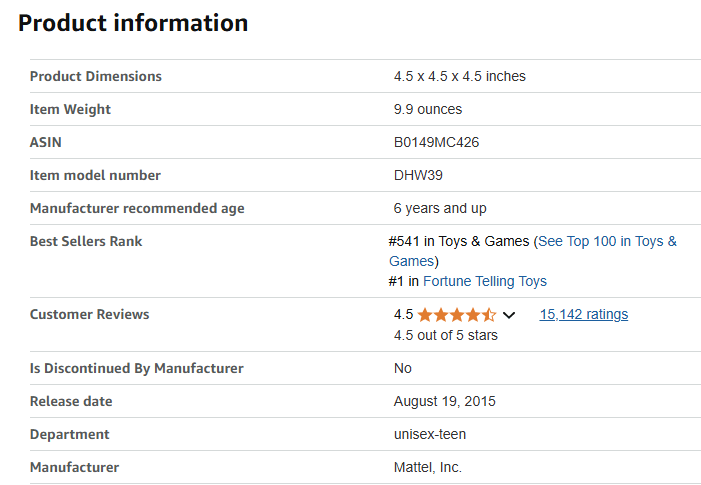
The Magic 8 Ball is correctly classified under Toys & Games › Novelty & Gag Toys › Fortune Telling Toys. This placement ensures it reaches shoppers browsing for playful, nostalgic, or giftable novelty items. The subcategory is highly relevant, since the toy’s core appeal is fortune-telling fun rather than general play, which helps visibility in filtered searches and keeps it aligned with direct competitors.
Providing consistent and accurate brand and manufacturer details improves search visibility, especially for branded queries. Many shoppers search by brand names, so matching the brand in your listing to what users type is crucial.
Make sure your brand name is spelled consistently across all listings and matches the registered name in Amazon’s Brand Registry. This not only helps with search matching but also supports brand protection, A+ Content eligibility, and other advanced brand tools.
The listing clearly identifies Mattel, Inc. as the manufacturer and aligns the brand with a well-known, trusted toy company. Consistency here strengthens branded search visibility, since many shoppers specifically look for “Mattel Magic 8 Ball”. The inclusion of details like model number (DHW39) and department (“unisex-teen”) further supports catalog accuracy and buyer trust.
Your seller name is another field that Amazon uses to assess search relevance, particularly for branded or niche queries. While it’s not as heavily weighted as product titles or backend keywords, including relevant terms in your seller name can provide a small boost in visibility, especially when shoppers search using brand-like or generic phrases.
For example, a seller name like “Eco-Friendly Kitchenware Co” may help your listings surface in searches related to “eco kitchenware” or “sustainable cooking tools”. This can be particularly effective for newer sellers without strong brand recognition, as the name itself can provide context for the product line.
That said, don’t treat the seller’s name as a keyword-stuffing opportunity. Amazon discourages excessive keyword use or misleading names, and the impact is limited if the rest of your listing isn’t optimized. But when used thoughtfully, your seller name can improve brand recall and serve as one more signal to align with customer intent.
Customers use diverse language when searching. Some might type “sofa”, others “couch”, or even “loveseat”. Including synonyms, regional variations, and plural/singular forms helps your listing appear for more search queries.
These variations can be woven naturally into bullet points and descriptions, or added to backend keywords. For example, if you’re selling “running shoes”, also consider including terms like “jogging sneakers”, “athletic shoes”, or “gym footwear”.
Think beyond literal synonyms, include use-case terms (“trail running”, “indoor training”), abbreviations (“GPS watch” vs. “Global Positioning System watch”), and alternate spellings (“color” vs. “colour”).
While it’s great to have all your keywords in the right places, the goal of Amazon is to sell! The algorithm is designed to understand how likely it is that a click will lead to a sale, meaning performance is just as important as keywords.
Conversion rate is a key performance metric in Amazon’s ranking algorithm. It measures how many visitors purchase after landing on your product page. Higher conversion rates indicate product-market fit, relevance, and customer satisfaction.
To improve conversions, ensure your listing is complete and persuasive: clear titles, sharp images, keyword-rich content, accurate descriptions, and competitive pricing. Adding FAQs and A+ Content can also increase trust and reduce friction, leading to more purchases.
Conversion rate is also tied to customer expectations. Make sure your listing sets the right expectations with accurate sizing, material details, and shipping info to reduce returns and boost satisfaction.
Sales velocity measures how quickly your product sells over time. It’s a direct signal to Amazon that your item is popular and in demand. Higher sales velocity typically leads to higher rankings, more visibility, and even a better chance of winning the Buy Box.
To build and sustain velocity, launch strategies often include aggressive PPC campaigns, time-limited promotions, and pricing incentives. Amazon wants to feature products that sell consistently, so maintaining momentum, especially post-launch, is crucial for ranking retention.
Monitor your performance using Amazon’s Business Reports or third-party tools to identify sales trends and address slowdowns early.
Read more: How to Increase Sales on Amazon: 19 Strategies
CTR measures how often people click on your listing after seeing it in search results. It reflects how appealing your product appears compared to competitors. A high CTR signals strong relevance and can improve rankings.
CTR is influenced by the quality of your main image, the clarity of your title, pricing, and review count. Make sure your title is concise and packed with the most important information. Use a high-resolution image that clearly shows the product and communicates professionalism.
Experiment with different images or titles to test what drives more clicks. If CTR drops, it’s a signal that your listing may not stand out in search results.
Sales history is one of the most powerful long-term signals in Amazon’s ranking algorithm. It reflects how well your product has performed over time, not just in isolated campaigns or short-term boosts. Amazon uses this data to assess product reliability, customer demand, and marketplace staying power.
A consistent sales record indicates that your product meets customer expectations and continues to attract interest. This helps Amazon predict future performance, making the algorithm more likely to favor your listing in search results. Listings with strong historical sales often get more impressions, better placement in category rankings, and preferential treatment.
Importantly, Amazon evaluates sales trends, not just volume. Sudden drops in sales can lead to ranking losses, even if the product had a strong launch. To maintain momentum, many sellers use a mix of PPC, seasonal promotions, and customer engagement tactics to keep sales steady throughout the product lifecycle.
Product reviews and ratings are critical trust signals for both shoppers and Amazon’s algorithm. A high average star rating and a strong number of recent, positive reviews increase the likelihood of conversions and higher rankings.
Amazon favors listings with steady review activity. Encourage customers to leave feedback through follow-up emails or packaging inserts (in line with Amazon’s guidelines). Respond professionally to negative reviews to show responsiveness and reduce their impact.
The Magic 8 Ball Retro benefits from a strong 4.5-star average across 15,000+ ratings, which positions it as a trustworthy, high-volume product. Most reviews (77%) are 5-star, highlighting fun, nostalgia, and giftability as key drivers of customer satisfaction. The AI-generated “Customers say” summary reinforces these positives and calls out quality, fun, memories, and value, while also surfacing recurring negatives like readability issues and liquid quality.
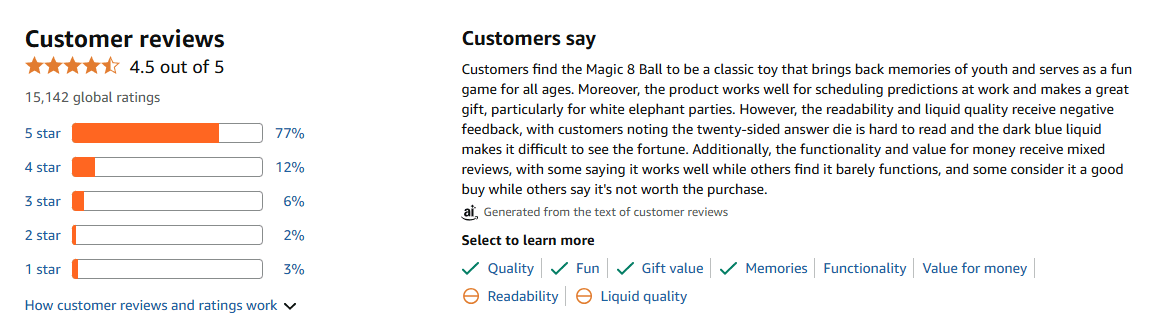
The top customer reviews echo these themes, with buyers praising the retro theme, lightweight build, and entertainment value. At the same time, critiques about hard-to-read answers indicate an area where the product detail page could better set expectations. By emphasizing benefits like “battery-free”, “classic entertainment”, and “great gift for all ages” while preemptively addressing readability concerns, the listing can align with customer sentiment and improve conversions.
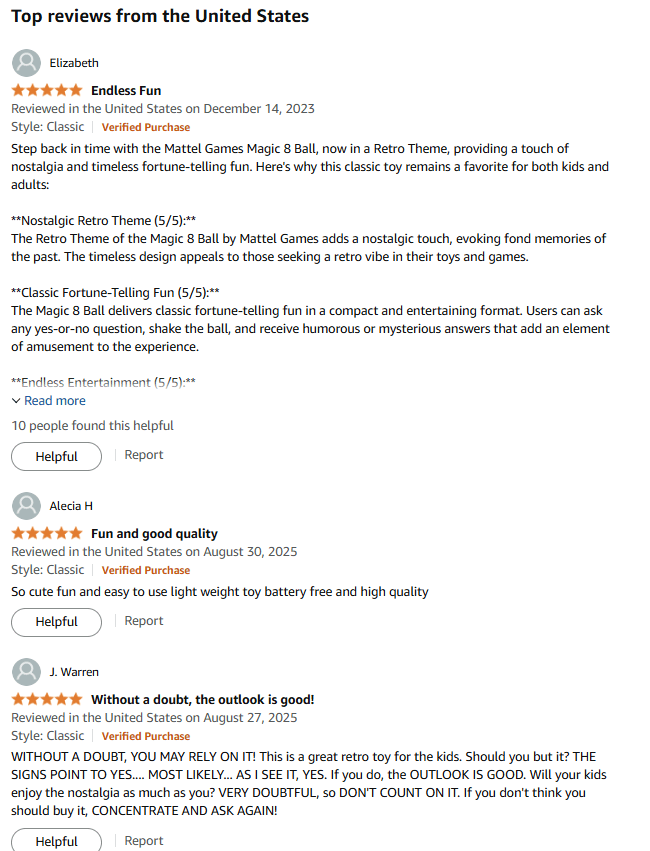
You can also use reviews to identify what customers like or dislike, then update your product page to address those concerns and highlight popular features.
Learn more about reviews:
Amazon tracks how your pricing compares to similar products in the same category. Competitive pricing improves your chance of appearing in search results, converting buyers, and winning the Buy Box.
But the lowest price doesn’t always win. Amazon evaluates value, which includes your product’s quality, reviews, and delivery speed. Avoid underpricing at the expense of margins or brand perception.
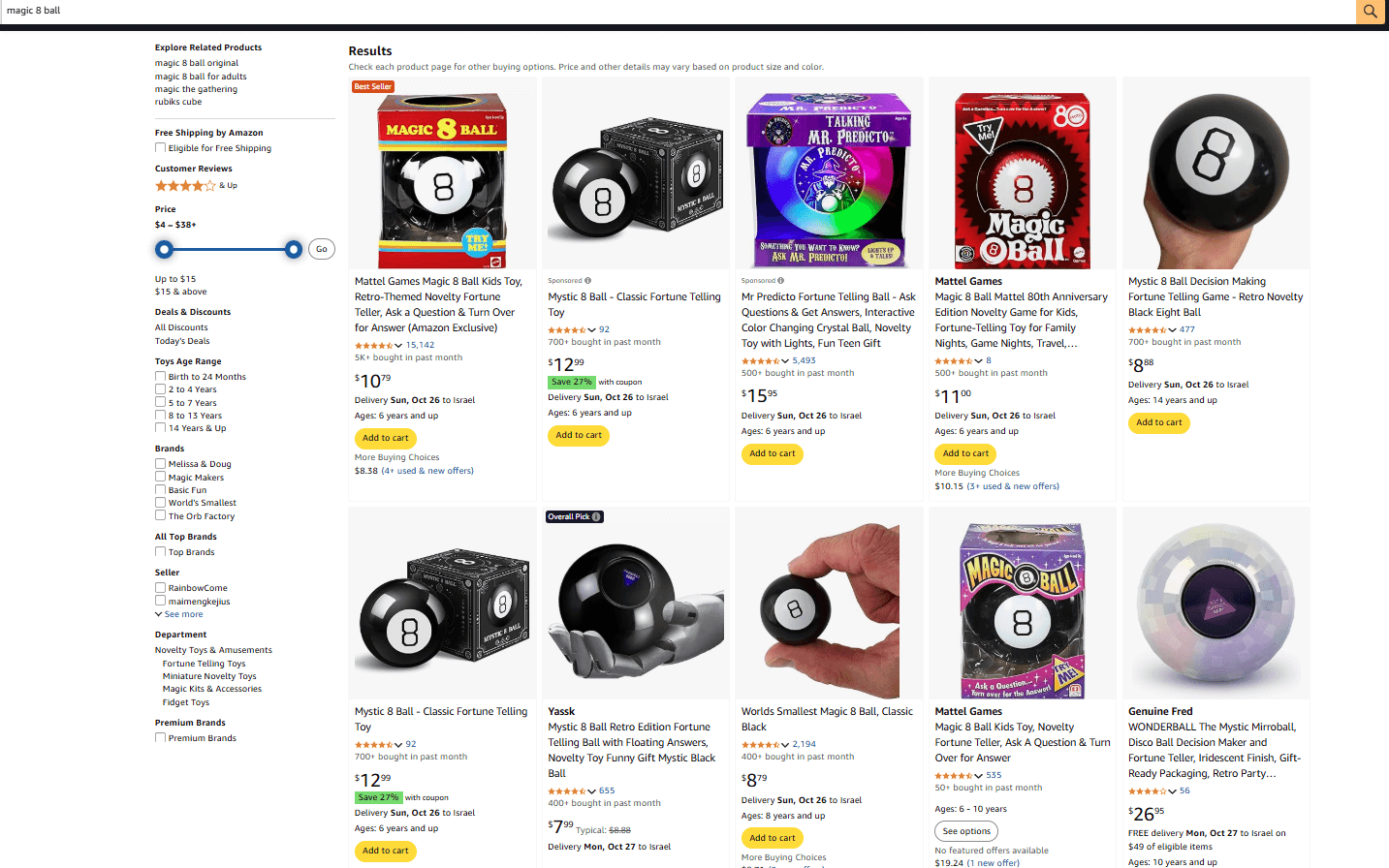
Despite not being the cheapest option, the Mattel Magic 8 Ball ranks as the top-listed product for the search term “magic 8 ball”. This shows how Amazon’s algorithm weighs more than price alone. Factors like strong brand recognition, high review volume (15K+ ratings), and consistent sales velocity help secure visibility and Buy Box preference. Competing listings, including lower-priced alternatives, are pushed down because they lack the same combination of trust signals and demand.
For Mattel, this positioning demonstrates that maintaining a balanced price point aligned with brand value can be more effective than undercutting competitors, especially when reinforced by positive reviews, Prime delivery eligibility, and brand strength.
Use dynamic pricing tools or monitor competitors manually to stay in line with market expectations. Consider bundling or offering promotions strategically during key shopping seasons to improve perceived value.
Inventory status directly impacts your search rankings. If your item goes out of stock, Amazon will suppress or demote your listing until inventory is replenished. Frequent stockouts can damage long-term visibility and sales velocity.
Use inventory forecasting tools to plan ahead, especially around sales events like Prime Day or holidays. For FBA sellers, ensure shipments arrive on time and stay within Amazon’s stock limits.
Keeping your product consistently available is essential not just for sales continuity, but also for maintaining momentum with the ranking algorithm.
Here are some of the ways that you can improve your brand’s visibility and authority on the Amazon platform.
Identify competitor products that target the same audience and fall within your price range. Focus on listings with strong sales volume, as they’re more likely to reveal patterns Amazon’s algorithm favors. Review competitors’ titles, bullet points, descriptions, and A+ Content to see how they position benefits, use keywords, and structure information.
Pay close attention to:
Use Similarweb Retail Intelligence to convert shopper data into insights and insights into actionable strategies, enabling a deeper level of Amazon competitor analysis that covers keywords, category trends, and product performance. Look at your competitors’ Amazon stores and their products to analyze what they are doing that you are not. This tool can also analyze your competition on Amazon, helping you analyze keywords, see category performance, and product performance.
Amazon’s own tools, like Product Opportunity Explorer and Brand Analytics, provide search volume and query performance data. But to go deeper, use Similarweb’s Amazon Keyword Research Tool. Unlike scraping-based tools, it analyzes real shopper searches from over 380 million products, giving you authentic keyword insights you can trust. You can:
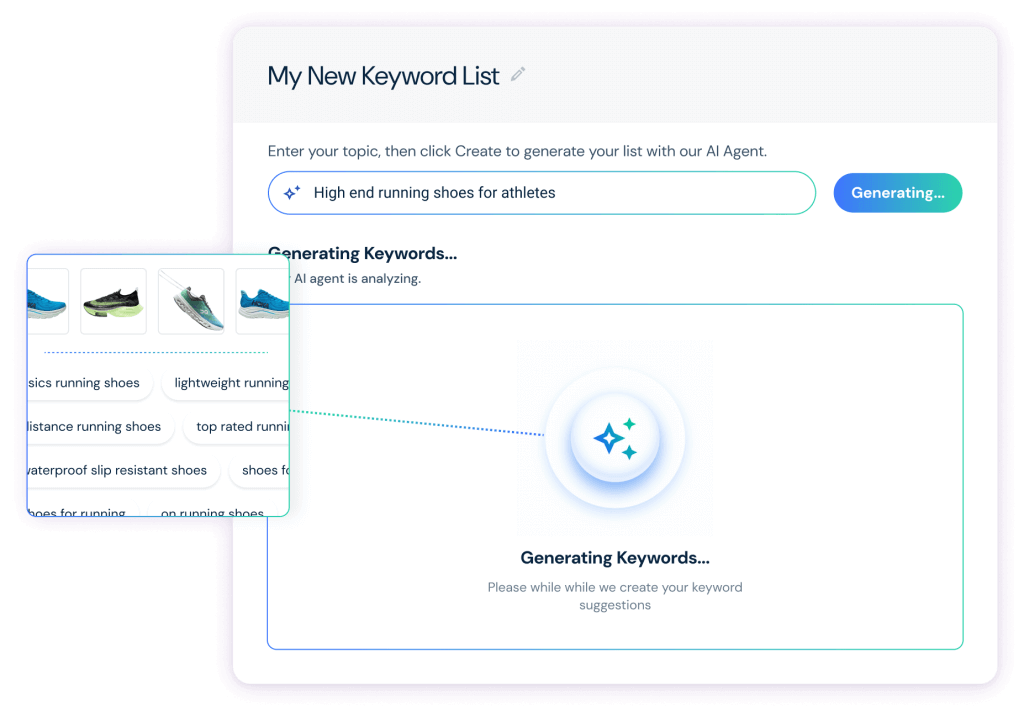
By combining short-tail and long-tail terms into your product title, bullets, backend keywords, and description, and validating them with Similarweb’s click and demand data, you maximize both visibility and conversion potential while staying competitive in your category.
The product title is the first piece of text customers see, and one of the most heavily weighted relevance signals for Amazon’s algorithm. Use this field to include your top two to four keywords while maintaining readability.
A strong title should:
While Amazon allows up to 200 characters, it’s best to keep titles between 60–80 characters for clarity and mobile display. The first 5–10 words matter most as they’re what users see in mobile and desktop search results.
The product description lets you expand on the benefits and use cases of your product while including secondary and long-tail keywords that didn’t fit into the title or bullets.
Use up to 2,000 characters to:
Structure your content for readability with short paragraphs, clear language, and natural keyword placement. Avoid keyword stuffing. Focus on delivering value to the reader. See our guide on how to optimize Amazon listings.
Pro tip: Create a buyer persona and write to their needs. Highlight differentiators that set your product apart from competitors. Use storytelling if appropriate. This adds context and can reduce return rates by setting accurate expectations.
Images are one of the top factors influencing click-through rates and conversions. Shoppers often judge the product based solely on its images before reading any text. Best practices for Amazon images include:
Use multiple image types:
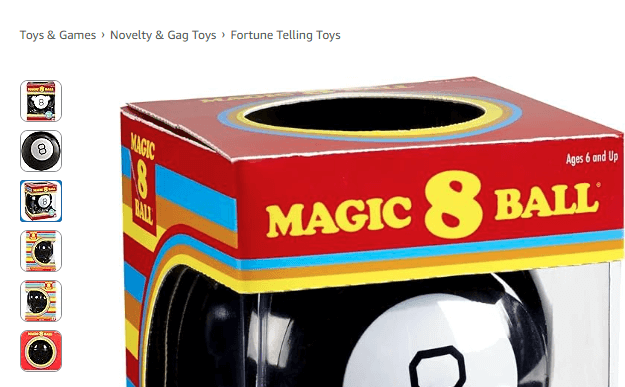
The Magic 8 Ball listing includes multiple high-resolution images that show the product from different angles and in its packaging, which supports shopper confidence. The main image meets Amazon requirements with a clean white background and the product filling the frame. Additional shots highlight the retro packaging and the iconic “8” face, reinforcing nostalgia and gift appeal.
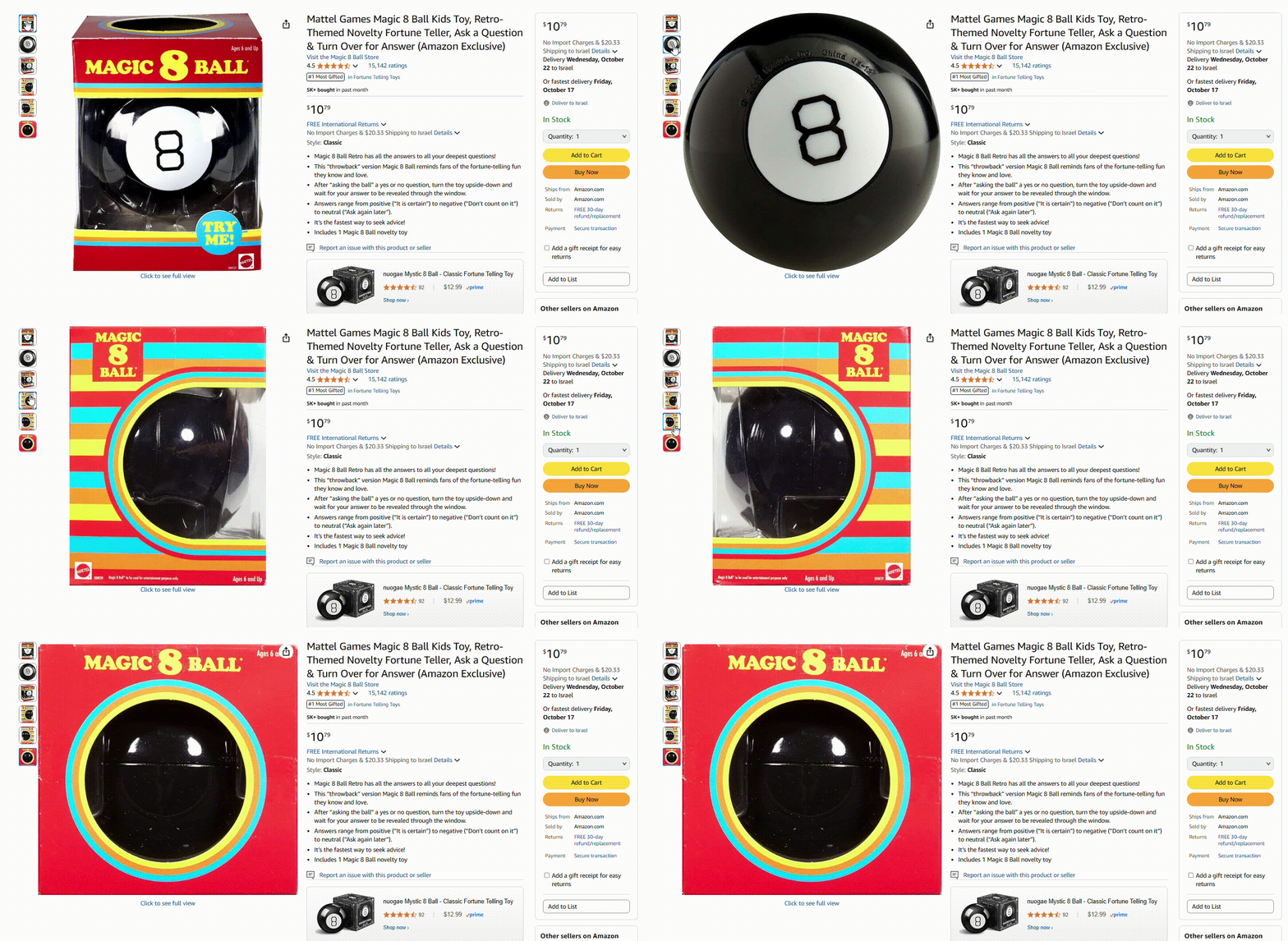
However, the set lacks lifestyle images (e.g., someone using the toy at a party or giving it as a gift) and infographics to explain features like “20 answers inside” or “no batteries required.” Adding these would help communicate value faster, improve scannability, and boost conversions, especially for shoppers browsing quickly on mobile.
Pro tip: Add descriptive alt-text with one or two relevant keywords for each image. Though not visible to buyers, alt-text supports accessibility and improves search visibility. If you’re Brand Registered, use A+ Content (enhanced product details available to brand-registered sellers and vendors) to include high-impact visuals, comparison charts, and branding elements.
Pricing is one of the most important levers for improving your listing’s performance. It affects conversion rate, sales velocity, and your competitiveness in the Buy Box. See our guide – How to Optimize Your Amazon Pricing Strategy.
Steps to optimize pricing:
Amazon’s Automate Pricing tool lets you dynamically adjust prices based on real-time market conditions. This helps you stay competitive without constantly making manual updates. Use pricing strategically to support product launches or drive velocity during promotions.
Backend search terms are hidden keywords you add in Seller Central to improve relevance without cluttering your listing. This section should capture any relevant terms not included in the title, bullets, or description.
Follow Amazon’s best practices:
This area is useful for entering foreign-language versions of your keywords or niche-specific terminology your audience may use.
Driving external traffic from Google to your Amazon listings can boost both sales and rankings. Amazon rewards products that attract traffic and convert well, even if the source is outside its own platform. Sellers who understand how Google search queries feed into their Amazon pages can capture shoppers earlier in the buying journey and direct them straight to high-converting listings.
Amazon SEO impacts visibility inside Amazon, as well as tying directly to traditional SEO. Because Amazon has such high domain authority, product listings often rank on Google for competitive keywords. That means an optimized Amazon page can win traffic both on Amazon and in Google search.
Similarweb makes this process more precise by showing which Google keywords drive traffic to Amazon product pages. With this data, you can identify high-value queries that lead buyers to Amazon and then optimize your own listings to capture that demand. For example, if a keyword like “best wireless headphones under $100” drives strong traffic to competitor products, you can target it through your listing content, backend keywords, or even Google Ads pointing directly to your Amazon page.
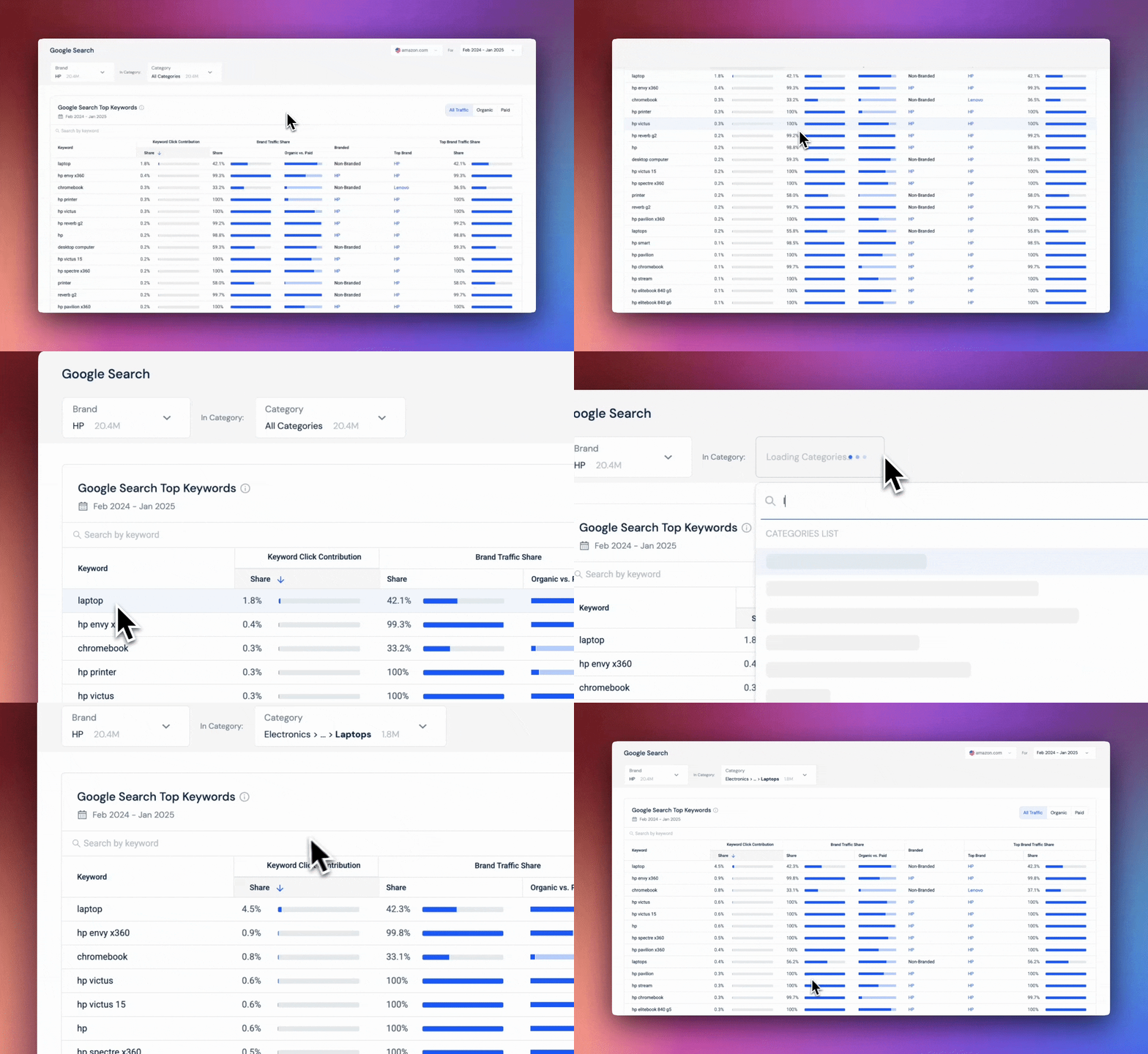
By combining keyword insights with traffic data, you can refine your external marketing strategy, align content with buyer intent, and strengthen your Amazon SEO performance at the same time.
PPC campaigns on Amazon amplify your reach by placing your products in front of high-intent shoppers. These paid placements appear at the top of search results and on product detail pages.
Amazon ads use the same keyword logic as organic listings. Strong campaigns start with solid keyword research and a well-optimized listing.
Benefits of Amazon PPC:
Over time, successful PPC performance can improve your organic ranking, creating a virtuous cycle of visibility and sales.
The Customer Questions & Answers section plays a bigger role in Amazon SEO than most sellers realize. It feeds Amazon’s A10 and AI models with fresh engagement signals and real customer language that can influence rankings.
Encourage buyers to ask questions, and proactively seed common queries to clarify key product details. Answer every question thoroughly and quickly. Clear responses reduce confusion, improve conversion rates, and increase time spent on the page, all of which are positive engagement metrics.
Use this section to:
Customer Q&A is also used by Amazon’s RUFUS assistant to generate responses, so improving this section makes your listing more likely to surface in AI-driven product recommendations.
Amazon SEO often challenges even experienced sellers, especially with the constant algorithm changes and new AI-driven features. The mix of keyword strategy, conversion optimization, and competitive pricing can leave even experienced sellers second-guessing their approach. That’s why having accurate data and clear insights is essential for making confident decisions.
Similarweb gives you the clarity you need at every stage of your Amazon journey. From keyword research to competitor tracking, it provides actionable data that helps you understand not just where you rank, but why. You can see what’s working for top sellers, uncover untapped opportunities, and track performance changes over time.
For Amazon sellers serious about growth, Similarweb is one of the most powerful tools available. It grounds your strategy in actionable data, so every optimization you make is backed by solid evidence. With the right insights, you can adapt faster, rank higher, and turn more clicks into lasting customers.
Why is Amazon SEO important for sellers?
Amazon SEO determines how easily shoppers can find your products in search results. Higher visibility leads to more clicks, more sales, and stronger long-term performance without relying solely on paid ads.
How long does it take to see results from Amazon SEO?
Results can vary, but most sellers see noticeable ranking and traffic improvements within four to eight weeks if changes are implemented effectively. Competitive niches may take longer to see significant movement.
What’s the difference between Amazon SEO and Google SEO?
Google SEO targets informational and transactional searches, while Amazon SEO is almost entirely transactional. Amazon’s algorithm focuses on factors tied directly to sales performance, such as conversion rates, sales velocity, and customer reviews.
Do I still need keywords in the age of AI-driven Amazon search?
Yes. Even with AI systems like COSMO and RUFUS interpreting search intent, keywords remain critical. They help Amazon’s algorithm connect your product with relevant buyer queries, while AI evaluates how well your listing matches the shopper’s needs.
How does Similarweb help with Amazon SEO?
Similarweb’s Retail Intelligence provides competitive intelligence, keyword insights, and traffic analysis, helping you identify high-value search terms, track competitor strategies, and monitor shifts in buyer behavior so you can adjust your listings for better rankings and conversions.

Senior SEO Specialist
Shai, with 10+ years in SEO, holds a Bachelor’s and an MBA. He enjoys TV shows, anime, movies, music, and cooking.
Top Ecommerce Companies in the USA: The 100 Brands Winning the Traffic Race in 2026

3 of the Sharpest Minds Weigh in on the State of Gen AI in 2026

Put the full picture at your fingertips to drive product views and sales
