





The Top 100 Most Visited Websites in the USA (August 2026)
by Shai Belinsky10 Min.
Sep 29, 2026
 Research Intelligence
Most companies know the industry leaders in their field. But, what about who’s losing steam or gaining traction? More importantly, why should companies want to know this?
In short, this information is what successful benchmarking is all about.
Knowing how to do benchmarking can be the difference between staying ahead of the curve and lagging behind.
Do it right, and get access to crucial intel that’ll help you stay afloat. Without it, you’ll start to feel that sinking feeling as those around you adapt to changes in the market while you struggle to know what’s happening, and why.
Read on to learn more about how to do benchmarking right.
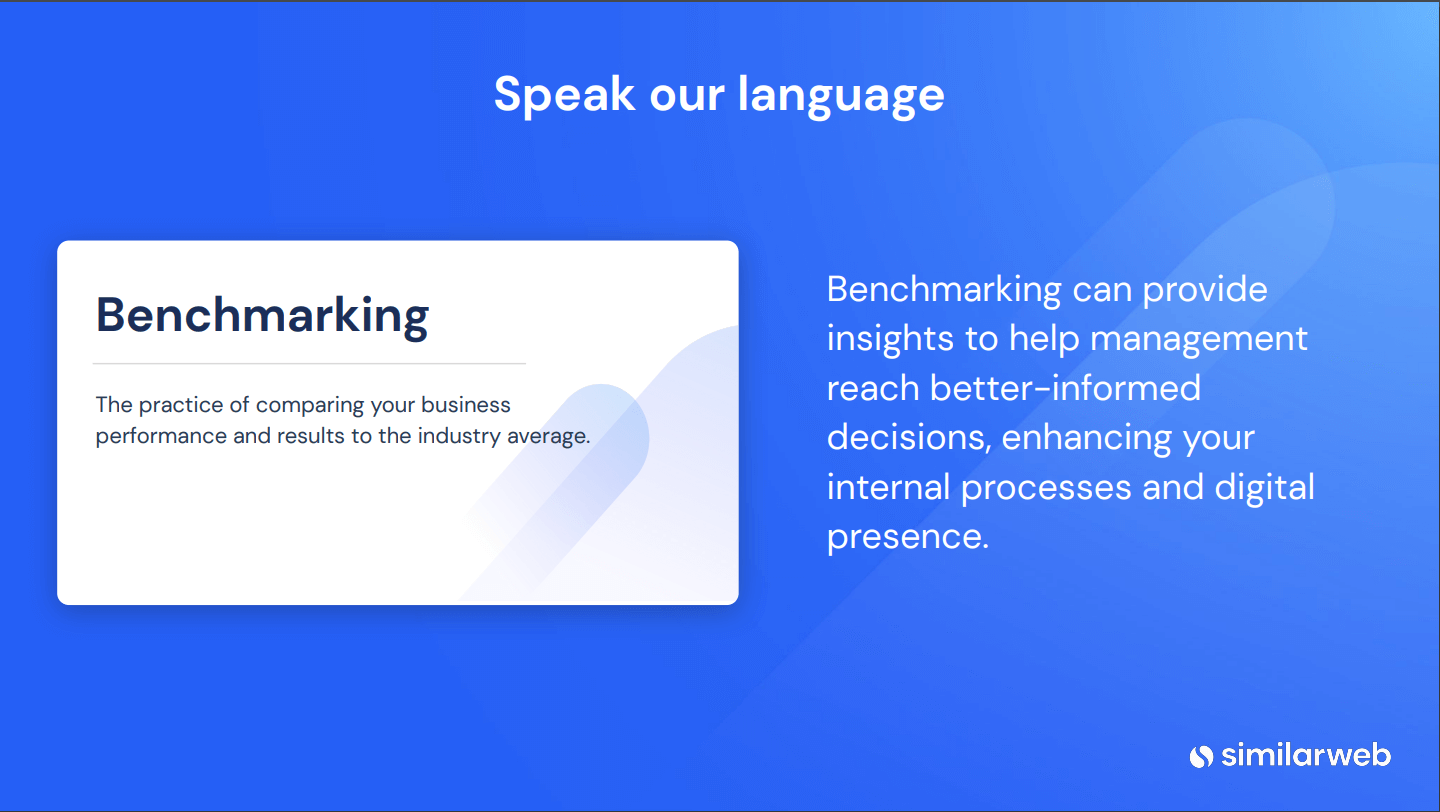
Before we show you how to benchmark, you’ll need to consider which type of benchmarking is right for you. While the core processes are much-of-a-muchness, the purpose and datasets used for each differ.
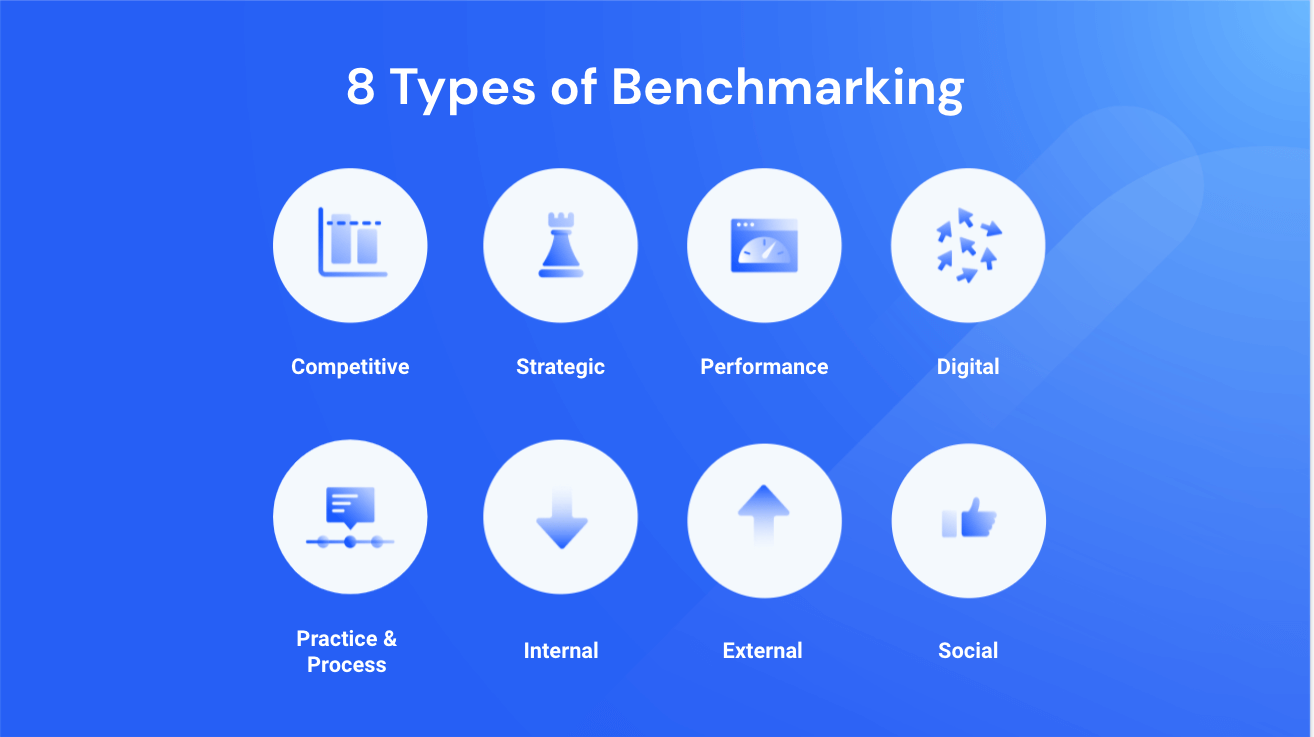
As I mentioned at the start, the first step in learning how to do benchmarking is to look at what you want to get out of it. Then, you can choose the right datasets to help you achieve those goals.
Market researchers and corporate strategy teams benefit from benchmarking by looking at the market and comparing it to industry averages.
Business intelligence and analytics teams monitor and track digital performance, and competitor insights, centralize data sources and make relevant decisions based on industry standards and benchmarks.
And, of course, customer satisfaction and audience analysis teams can use benchmarking to better understand customer behavior, and audience consumption habits, and to develop new ways to bring in new customers.
Doing benchmarking regularly helps you to:
As a company that knows a thing or two about benchmarking, we can say with confidence that any business can benefit from learning how to do benchmarking right.
Depending on the type of benchmarking you choose, there’ll be slightly different ways of working for each. In this section, I’ve outlined the four core benchmarking steps you can apply to almost any scenario.
I promise, once you’ve learned how to do benchmarking, and start to see results, you’ll quickly become hooked.
One of the biggest benefits of benchmarking is that the process can help you reach your goals. This is why the first step of benchmarking is to clearly outline your goals. Make sure these goals are specific, and where possible, contain a numerical attribute. My default method for goal setting is the SMART approach, but feel free to go your own way!
So, establish what your goals are, write them down, and be sure to revisit them throughout the process.
There are a wide range of digital engagement metrics, the most popular tend to be: bounce rate, website stickiness (unique visitors/total visits), marketing channels, device split, session duration, and pages per visit.
These metrics give you valuable information that helps you identify opportunities, and track real-time data for your market.
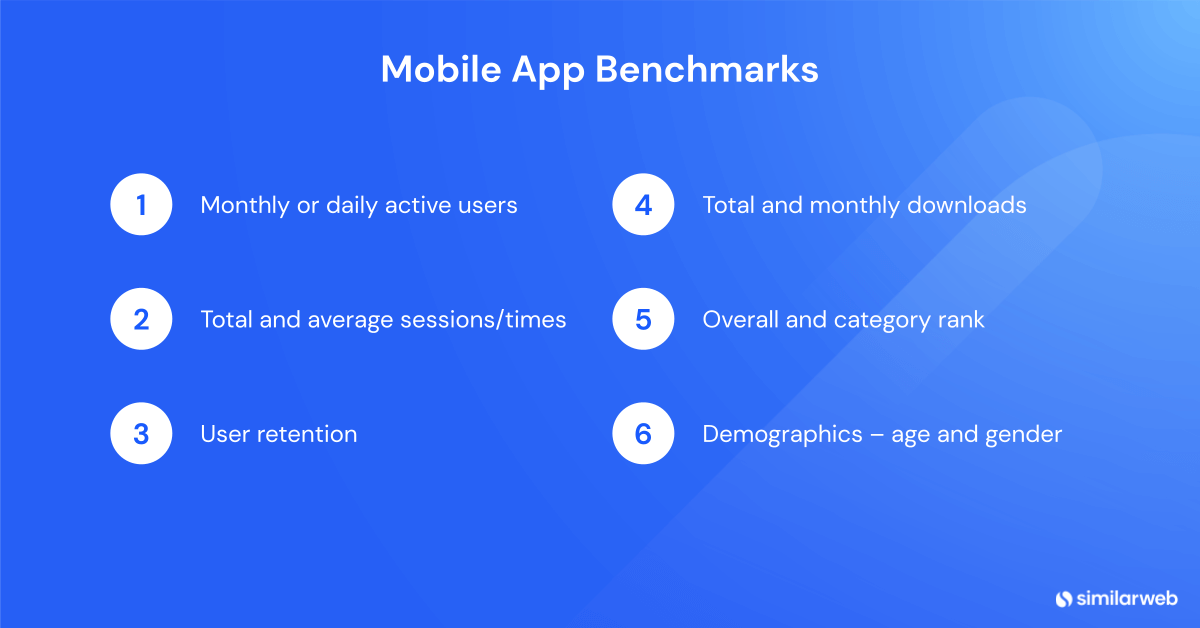
Consider mobile app benchmarks too, as most markets are being impacted by apps in one way or another.
Key mobile benchmarks you need to track include:
Mobileapp intelligence tools help you quickly uncover these key metrics. When you combine this data with web analytics, you get a complete picture of your rivals’ digital landscapes; which is key for successful benchmarking.
Just like choosing the right type of benchmarking will determine the right datasets you use; your industry will also dictate the specific metrics you’ll want to track. So, aside from the standard metrics from Step 2 above, you’re also going to need to add market-specific metrics into the mix.
Let’s look at a few different industries and see what we can learn from critical metrics and insights, comparing Q1 2020 vs. Q1 2021.
First up: publishers and media.
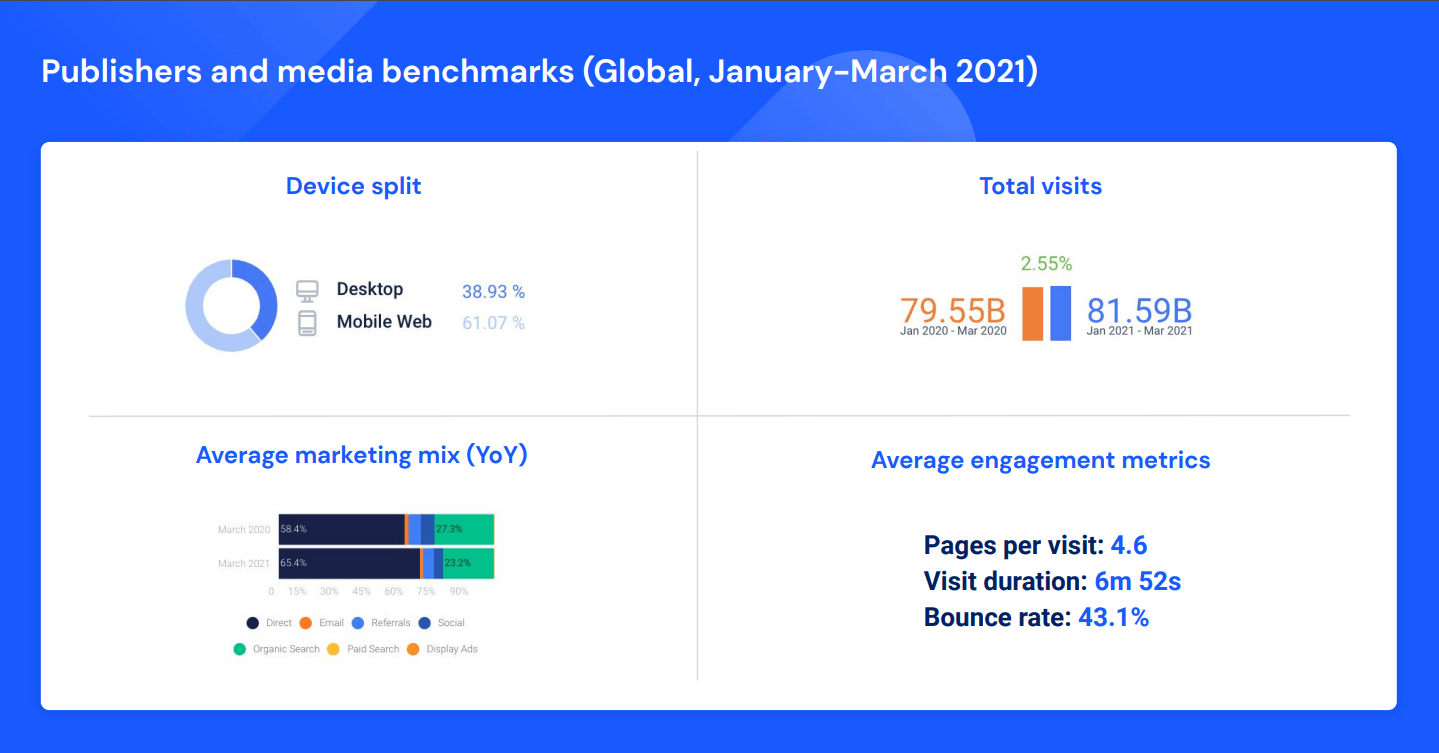
We can see that organic search dropped from 27% to 23%. However, direct traffic increased overall by 7%.
This tells us about an important shift in audience behavior over this period. More visitors enter publishers’ sites directly, while fewer come via organic search.
A BI analyst at a publisher needs to pay close attention to these benchmarks to ensure that their site’s growth remains in line (or above) the industry average to make improvements to content and SEO.
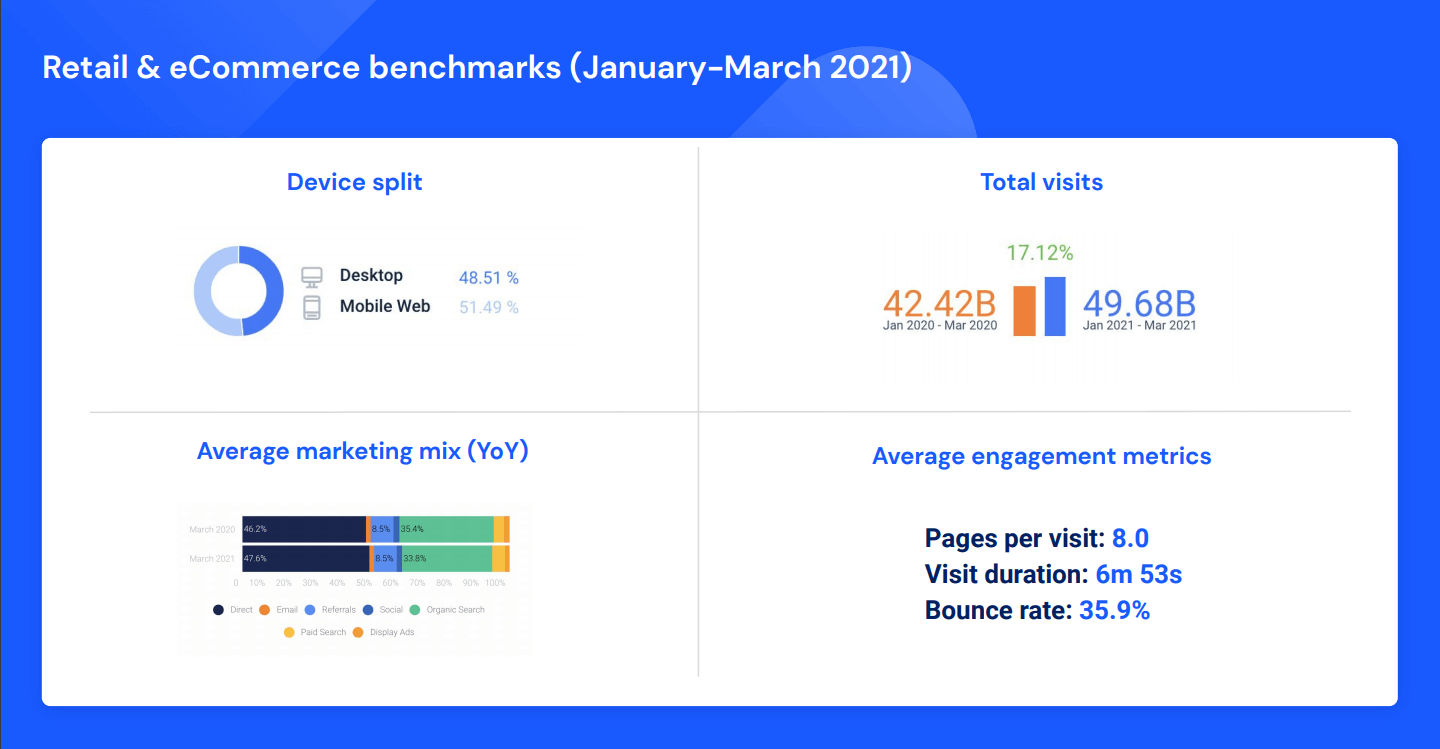
If we look at retail and ecommerce benchmarks, we see that total visits increased to websites in this industry by 17% over the same period.
When your industry experiences growth, you want to be leading it. This highlights the importance of forming an organic search strategy and building strong brand awareness.
If you’re randomly digging around the net, the industry-specific data you need isn’t always quick to find. Similarweb has both market and site-specific data so you can see the performance of your entire competitive landscape and benchmark for continuous improvement. What’s more, when it comes to revisiting and re-measuring those benchmarks, it’s as easy as ABC; and it’s fast too.
This is all about tracking key social media channels for mentions and analyzing the conversation around your brand and others in the industry.
Let’s put it this way: If people talk about something online, you want to know and take action.
From social listening, you can:
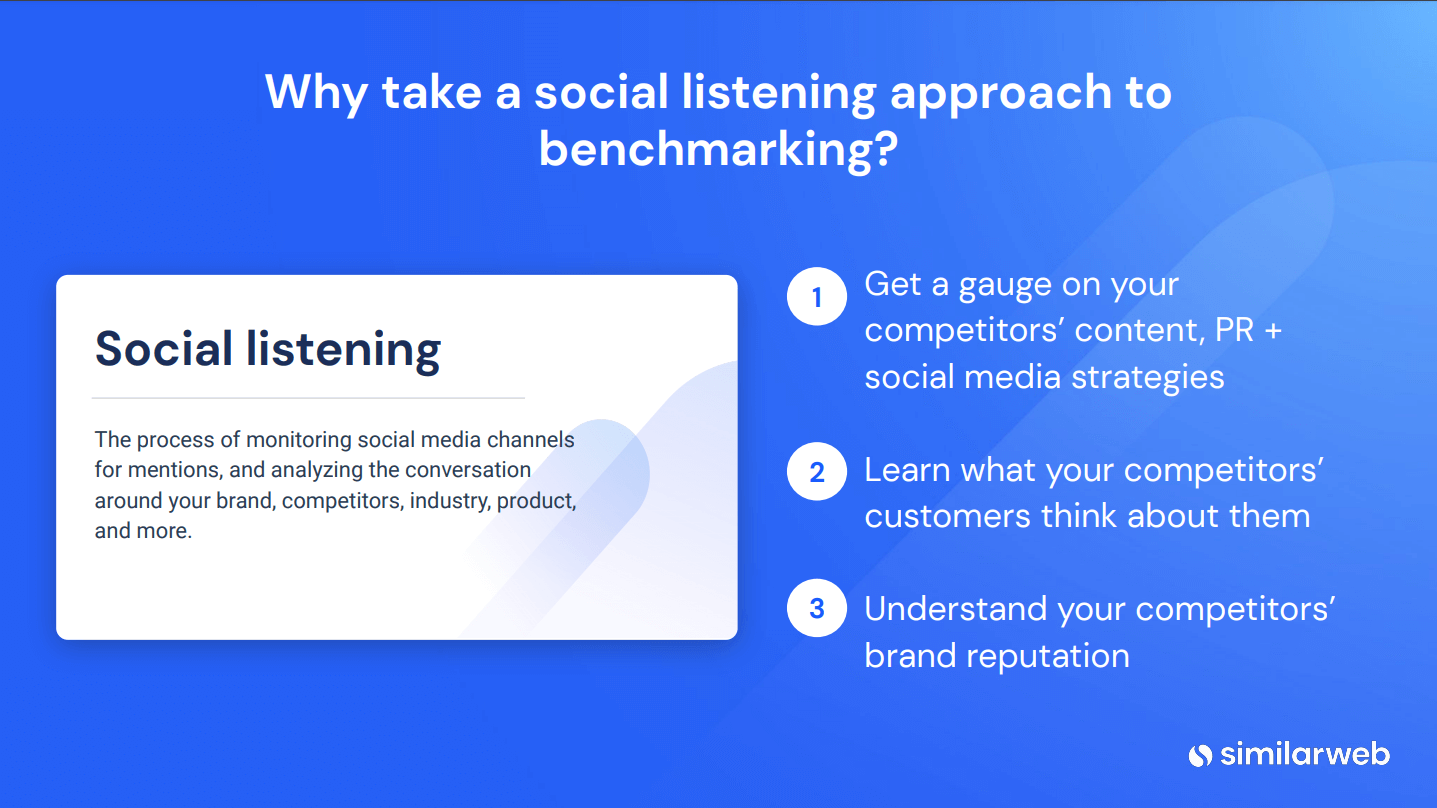
This benchmarking method can be invaluable to marketing managers, content teams, sales teams, product teams, and more. It provides valuable context and insights you just can’t get from analyzing stats alone.
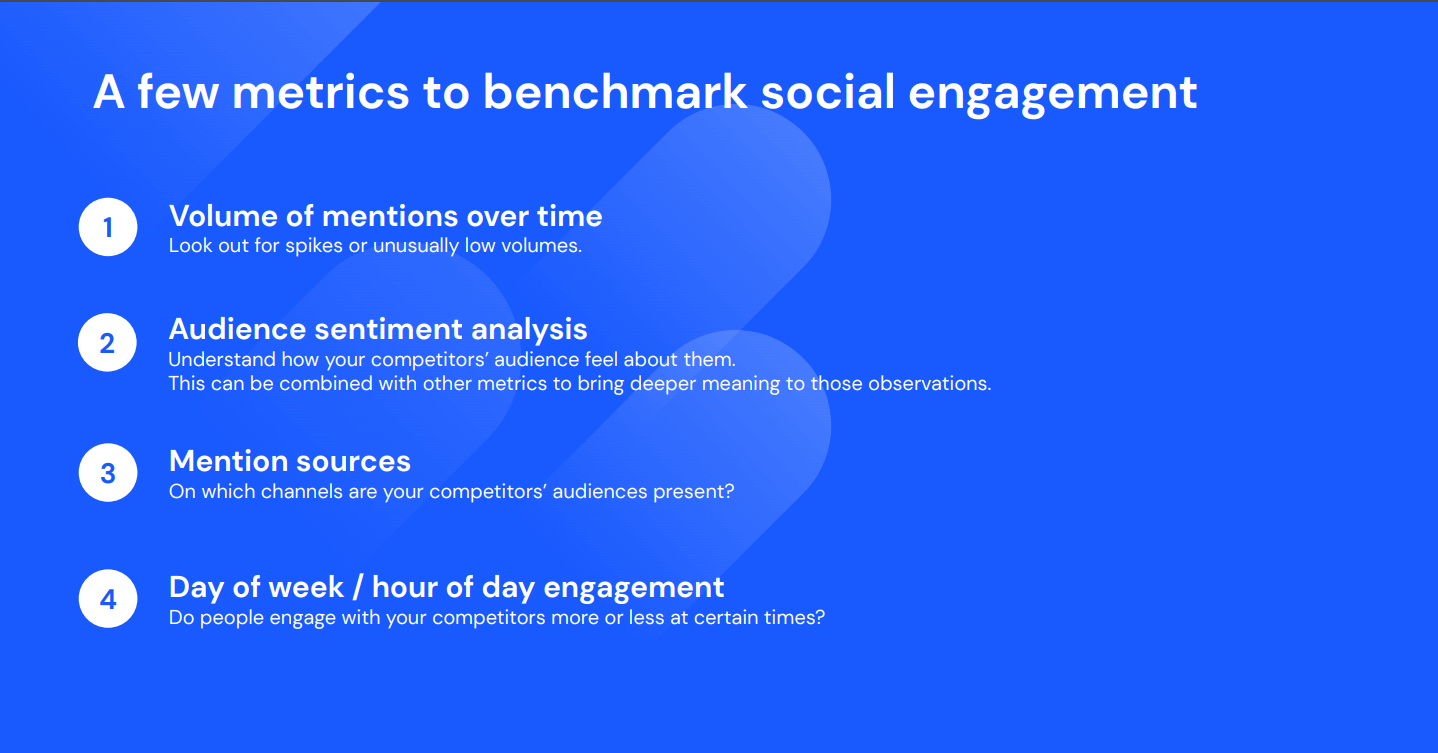
There are four key points to consider when benchmarking for success on social media.
Wrapping up……
My final piece of advice about how to do benchmarking is really just good housekeeping. When you start, make sure you’ve got a tracker set up to keep a record of your findings. Use the same figures for each company you benchmark against – and periodically update, compare, and analyze the results.
You can get a basic competitive analysis template here to get some inspiration.
You can watch our benchmarking webinar for a video guide to better benchmarking and beating the competition.
We’ve also included an all-inclusive playbook to guide you through each step of the benchmarking process.
What are the four steps of benchmarking?
The four main benchmarking steps are planning, analysis, integration, and action.
How do you benchmark a mobile application?
To do benchmarking for a mobile app, follow these four steps. 1. Choose the apps you’re going to benchmark yourself against. 2. Select which performance areas to benchmark. 3. Rate each performance area you’ve chosen from 1-10. 4. Analyze the results.
What are some metrics to benchmark social engagement?
Some of the best social benchmarking metrics include volume of mentions over time, audience sentiment analysis, and time of engagement.

by Molly Winik
Senior Content Marketing Manager
Molly has 8+ years of experience in marketing, content creation, and PR. Her work has been featured on Mention, The Times of Israel, and Culture Trip.
The Top 100 Most Visited Websites in the USA (August 2026)
Similarweb Named in Forrester's Answer Engine Optimization Technologies Landscape, Q3 2026

Anthropic IPO: What Claude's Web and App Data Show
Contact us to set up a call with a market research specialist
